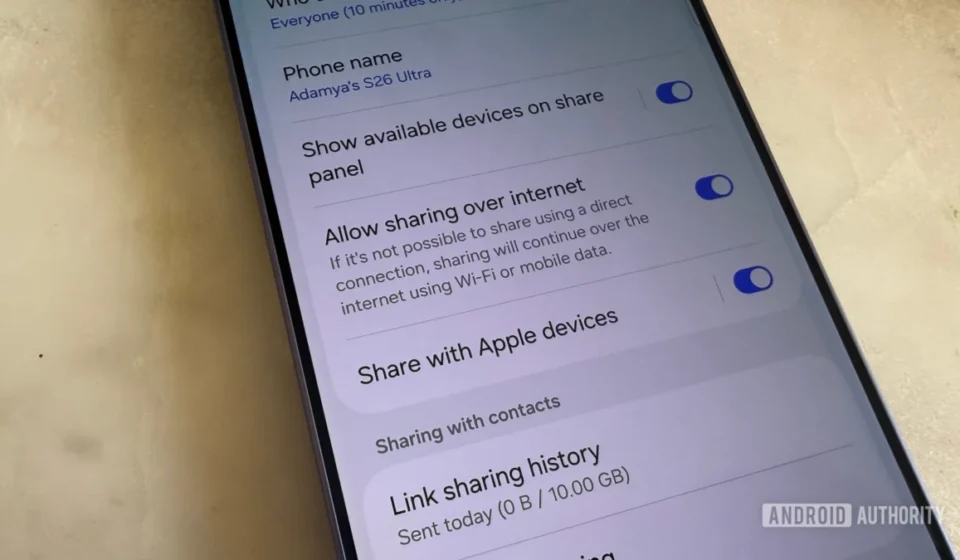
Galaxy S26 owners in the US can start using Quick Share with their AirDrop friends

United States-based owners of the Samsung Galaxy S26 are reporting the early arrival of a significant software update that introduces an AirDrop-compatible file-sharing feature, enabling seamless transfers between their Samsung flagships and Apple iPhones. This development marks a pivotal moment in mobile device interoperability, as Samsung delivers on its commitment to an aggressive rollout schedule, with the update reaching consumers ahead of the anticipated week’s end target for the U.S. market. The initial rollout commenced in Samsung’s native South Korea earlier in the week, demonstrating the company’s swift execution in deploying this highly anticipated functionality.
The Interoperability Breakthrough: Bridging Ecosystems
For years, the mobile technology landscape has been characterized by "walled gardens," ecosystems meticulously cultivated by major players like Apple and Google, often limiting seamless interaction between devices running different operating systems. Apple’s AirDrop, introduced in 2011, has long been lauded for its effortless peer-to-peer file sharing capabilities within the iOS and macOS ecosystems, setting a benchmark for convenience that Android users often envied. While Android platforms have developed their own solutions, such as Google’s Nearby Share and Samsung’s Quick Share, true direct interoperability with AirDrop has remained an elusive goal.
The current update for the Galaxy S26 series appears to fundamentally alter this dynamic. Reports from users, initially surfacing on platforms like Reddit through threads started by individuals such as "Fun-Building-8146," indicate that Galaxy S26 owners can now effortlessly send and receive files from iPhones, a capability explicitly highlighted by the original source encouraging users to "grab your S26, and grab an iPhone, and feel free to go nuts sending files back and forth to your heart’s content." This functionality addresses a long-standing pain point for consumers, particularly those living in mixed-OS households or professional environments where both Android and iOS devices are prevalent. The ability to bridge this gap without resorting to cumbersome third-party applications, cloud storage workarounds, or traditional Bluetooth transfers represents a significant stride towards a more open and user-centric mobile experience. This move by Samsung underscores a growing industry trend towards greater device harmony, potentially signaling a future where core functionalities transcend traditional operating system boundaries.
An Accelerated Rollout: Exceeding Expectations
Samsung’s strategic approach to software updates has been notably assertive in recent times, and the deployment of this AirDrop-compatible feature for the Galaxy S26 series exemplifies this commitment. The company had previously communicated its intention for a rapid global distribution, beginning in South Korea at the start of the week and targeting a U.S. release before its conclusion. The actual availability of the update in the U.S. ahead of this ambitious schedule highlights Samsung’s operational efficiency and dedication to enhancing its flagship devices.
This accelerated rollout comes amidst a period of intense activity for Samsung’s mobile software division. Simultaneously, the company has been expanding access to the One UI 8.5 beta program for a growing number of Galaxy devices, demonstrating a dual focus on delivering cutting-edge features to its latest hardware while also refining the core user experience across its broader portfolio. Such concurrent development and deployment initiatives are resource-intensive and speak to Samsung’s robust software engineering capabilities. The swiftness of this update’s arrival is particularly impactful given the high demand for cross-platform solutions and the competitive nature of the smartphone market, where timely feature delivery can significantly influence user satisfaction and brand perception. By prioritizing its flagship Galaxy S26 series for this groundbreaking update, Samsung strategically positions its premium devices at the forefront of innovation, offering a compelling reason for consumers to invest in its latest hardware.
Background: The Evolution of Mobile File Sharing
The quest for seamless file sharing between mobile devices has been a continuous thread in the evolution of smartphone technology. Before the advent of sophisticated wireless sharing protocols, users relied on basic Bluetooth transfers, which were often slow, unreliable, and cumbersome, especially for larger files. Early Android devices attempted to address this with various proprietary solutions, but none achieved the widespread adoption or seamless integration seen with Apple’s AirDrop.
Apple’s AirDrop, introduced with iOS 7 in 2013 (though first seen on macOS Lion in 2011), revolutionized local file sharing by leveraging a combination of Bluetooth Low Energy (for discovery and pairing) and Wi-Fi Direct (for high-speed data transfer). Its intuitive user interface and reliable performance quickly made it a cornerstone feature of the Apple ecosystem, contributing significantly to the perception of iOS as a more integrated and user-friendly platform. For Android, the response was more fragmented. Various manufacturers implemented their own sharing solutions, such as Samsung’s Quick Share, LG’s ShareIt, and Huawei’s Share. However, these solutions primarily functioned within their respective brand ecosystems, failing to offer a universal Android-to-Android or Android-to-iOS solution.
In 2020, Google introduced Nearby Share, a feature designed to provide a more standardized AirDrop-like experience across the broader Android ecosystem. Nearby Share leverages Bluetooth, Bluetooth LE, Wi-Fi, or Wi-Fi Direct to allow quick and easy sharing between Android devices, Chromebooks, and even some Windows PCs. Samsung’s Quick Share, also launched in 2020, offered similar functionality with additional features tailored for Galaxy devices. While both Nearby Share and Quick Share significantly improved the Android sharing experience, they still operated largely independently of Apple’s AirDrop, maintaining the ecosystem divide.
The current update for the Galaxy S26, allowing direct sharing with iPhones, represents a monumental leap. While the precise technical mechanisms facilitating this direct AirDrop compatibility are yet to be fully detailed by Samsung, it likely involves either a direct integration with Apple’s AirDrop protocol (which would imply unprecedented collaboration) or, more plausibly, an advanced implementation of a new cross-platform standard. This could potentially build upon initiatives like the joint Google and Apple standard for detecting unwanted tracking devices, which demonstrated a willingness by both tech giants to collaborate on interoperability standards for critical user functions. Such a move would be indicative of a broader industry shift towards open standards and enhanced user freedom, moving beyond proprietary limitations to foster a more connected digital environment.
Technical Prerequisites and Accessibility
For Galaxy S26 owners eager to utilize this new cross-platform file-sharing capability, a specific technical prerequisite has been identified: the device must be running Google Play Services version 26.11.xx or newer. Google Play Services is a proprietary background service and API package that provides core functionalities to Android devices, including authentication services, synchronized contacts, location services, and, crucially, updates to system components like Nearby Share and other critical connectivity features.
This requirement underscores the intricate relationship between Samsung’s proprietary software (One UI), Google’s foundational Android services, and the hardware capabilities of the Galaxy S26. Google Play Services often updates independently of the main Android operating system, allowing Google to push critical security patches and feature enhancements to millions of Android devices without requiring a full OS update from the device manufacturer. The dependency on a specific version of Google Play Services suggests that the new AirDrop-compatible feature likely leverages or integrates deeply with Google’s existing sharing infrastructure, which has been continually refined to improve speed, reliability, and security.
Users can typically check their Google Play Services version by navigating to their device’s Settings menu, then to "Apps" or "Apps & notifications," finding "Google Play Services" in the list, and checking its version number. Updates for Google Play Services are usually pushed automatically in the background, but users can sometimes manually trigger an update through the Google Play Store or by ensuring their device has a stable internet connection. Ensuring this foundational component is up-to-date is crucial for unlocking the full suite of features and performance enhancements delivered through the latest software updates, including this groundbreaking file-sharing capability.
The Scope and Future of the Rollout
While the immediate excitement revolves around the Galaxy S26 series, the scope of this update’s availability and its future expansion are critical considerations for the broader Samsung user base. Currently, the AirDrop-compatible feature is exclusive to the Galaxy S26. This initial exclusivity to Samsung’s latest flagship line is a common strategy in the smartphone industry, allowing manufacturers to highlight the premium capabilities of their newest devices and to serve as a testing ground for cutting-edge features before broader deployment.
Notably, the recently announced Galaxy A37 5G and Galaxy A57 5G, despite arriving with the latest One UI 8.5, will not support this AirDrop-compatible sharing at launch. This distinction suggests that the feature might require specific hardware components present in the S26 series, or that Samsung is strategically staggering its rollout to manage resources and maintain feature differentiation between its flagship and mid-range offerings. However, Samsung has provided a promising outlook for other Galaxy device owners, committing to extend this support to "other, non-S26 Galaxy devices at a later date."
The lack of specificity regarding which devices will receive the update and a precise timeline leaves room for speculation. Historically, Samsung tends to prioritize its recent flagship devices first (e.g., previous S series, Z Fold/Flip series), followed by older flagships, and then eventually some premium mid-range models. The technical requirements, particularly concerning the Google Play Services version and potential hardware dependencies, will likely dictate the breadth of this future expansion. Users of older Galaxy S series, Note series, or Z series devices will undoubtedly be awaiting further announcements from Samsung, hoping that their devices will eventually gain access to this highly desirable interoperability feature. The phased rollout strategy allows Samsung to gather user feedback, address any unforeseen issues, and optimize performance before a wider deployment, ensuring a stable and reliable experience for all compatible devices.
Strategic Implications for Samsung and the Mobile Industry
This move by Samsung to introduce an AirDrop-compatible feature carries profound strategic implications, not only for the South Korean tech giant but for the entire mobile industry.
Enhancing User Experience and Brand Loyalty
For Samsung, integrating this cross-platform sharing capability directly addresses a significant pain point for many users. The frustration of not being able to easily share files between Android and iOS devices has often led to friction, particularly for users in households with mixed device ecosystems. By offering a seamless solution, Samsung significantly enhances the overall user experience of the Galaxy S26, potentially increasing customer satisfaction and fostering greater brand loyalty. This feature could also serve as a powerful differentiator, attracting consumers who might otherwise have been swayed by Apple’s ecosystem advantages, especially if they value interoperability with friends, family, or colleagues who use iPhones. It positions Samsung as a forward-thinking innovator, willing to break down traditional barriers for the benefit of its users.
Competitive Landscape Shift
The introduction of an AirDrop-compatible feature directly challenges one of Apple’s long-standing competitive advantages. AirDrop has been a key factor in Apple’s ecosystem lock-in, making it harder for users to switch away from iPhones or MacBooks due to the convenience of intra-ecosystem sharing. By neutralizing this advantage, Samsung puts direct pressure on Apple and other Android OEMs. It forces competitors to re-evaluate their own strategies regarding interoperability and proprietary features. This could lead to a more open and competitive market where device choice is less dictated by ecosystem constraints and more by hardware, software design, and specific features. Furthermore, it might push Google to accelerate the development and adoption of universal cross-platform standards for Android, potentially unifying various OEM-specific sharing solutions under a more cohesive framework.
A Precedent for Future Collaborations
Perhaps the most significant long-term implication is the precedent this sets for future collaborations between major tech rivals. Historically, proprietary standards have been the norm, fostering competition but often at the expense of user convenience. The explicit mention of sending files between a Galaxy S26 and an iPhone suggests a level of interoperability that was once unthinkable. This could pave the way for other cross-platform functionalities, such as universal messaging standards, seamless smart home device control across ecosystems, or even more integrated health data sharing. The willingness of major players to collaborate, or at least to develop compatible solutions, signals a potential shift towards a more user-centric approach where technology serves the user, rather than locking them into a specific brand. This could lead to a future where the choice of smartphone is less about which ecosystem one belongs to and more about individual preferences for hardware design, camera capabilities, or specific software enhancements.
Market Context and User Adoption
The timing of this rollout is particularly astute, as Samsung continues to vie for market leadership in the global smartphone arena. While Apple often dominates the premium segment in key markets like the U.S., Samsung maintains a robust global market share, particularly across a wider range of price points. The Galaxy S26, as Samsung’s flagship offering, represents the pinnacle of its mobile technology. Equipping this device with a feature that directly addresses a major cross-platform pain point could significantly bolster its appeal in competitive markets.
The immediate positive reaction from users, as evidenced by early Reddit discussions, underscores the strong demand for such functionality. Users are not just looking for powerful hardware; they are increasingly seeking seamless integration and freedom from technological silos. The ease with which this feature allows file transfer between Android and iOS devices removes a significant hurdle for users, potentially simplifying their digital lives and enhancing their daily interactions with technology. This could translate into increased sales for the S26 series, particularly among individuals or families who previously hesitated due to interoperability concerns. Moreover, the feature highlights Samsung’s responsiveness to consumer needs, further cementing its reputation as a user-focused brand in a fiercely competitive industry.
Conclusion: A Step Towards a More Open Mobile Ecosystem
The early and aggressive rollout of an AirDrop-compatible file-sharing feature for the Samsung Galaxy S26 series represents more than just a software update; it signifies a substantial shift in the mobile technology paradigm. By bridging the long-standing divide between Android and iOS ecosystems, Samsung has delivered a groundbreaking capability that enhances user experience, challenges established competitive advantages, and sets a promising precedent for future interoperability.
This development underscores Samsung’s unwavering commitment to innovation and its strategic intent to position its flagship devices at the forefront of technological advancement. While the full scope and technical intricacies of this feature are still unfolding, its immediate impact on user convenience and the broader mobile landscape is undeniable. As the industry moves towards a more interconnected future, Samsung’s bold step with the Galaxy S26 heralds a potential new era where device ecosystems become less about proprietary barriers and more about seamless, user-centric interaction, ultimately benefiting consumers across the globe. The promise of extending this functionality to other Galaxy devices in the future further solidifies Samsung’s vision for a more integrated and accessible digital world.