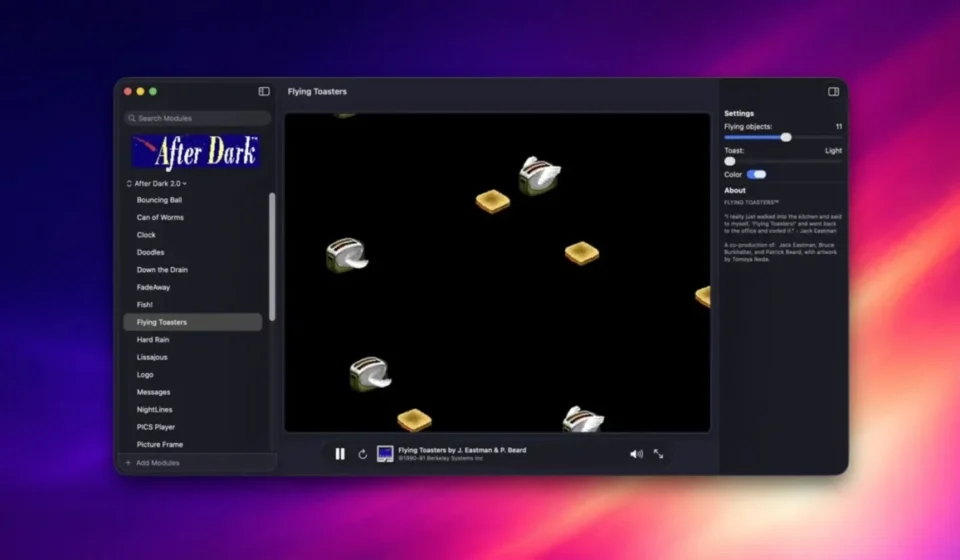

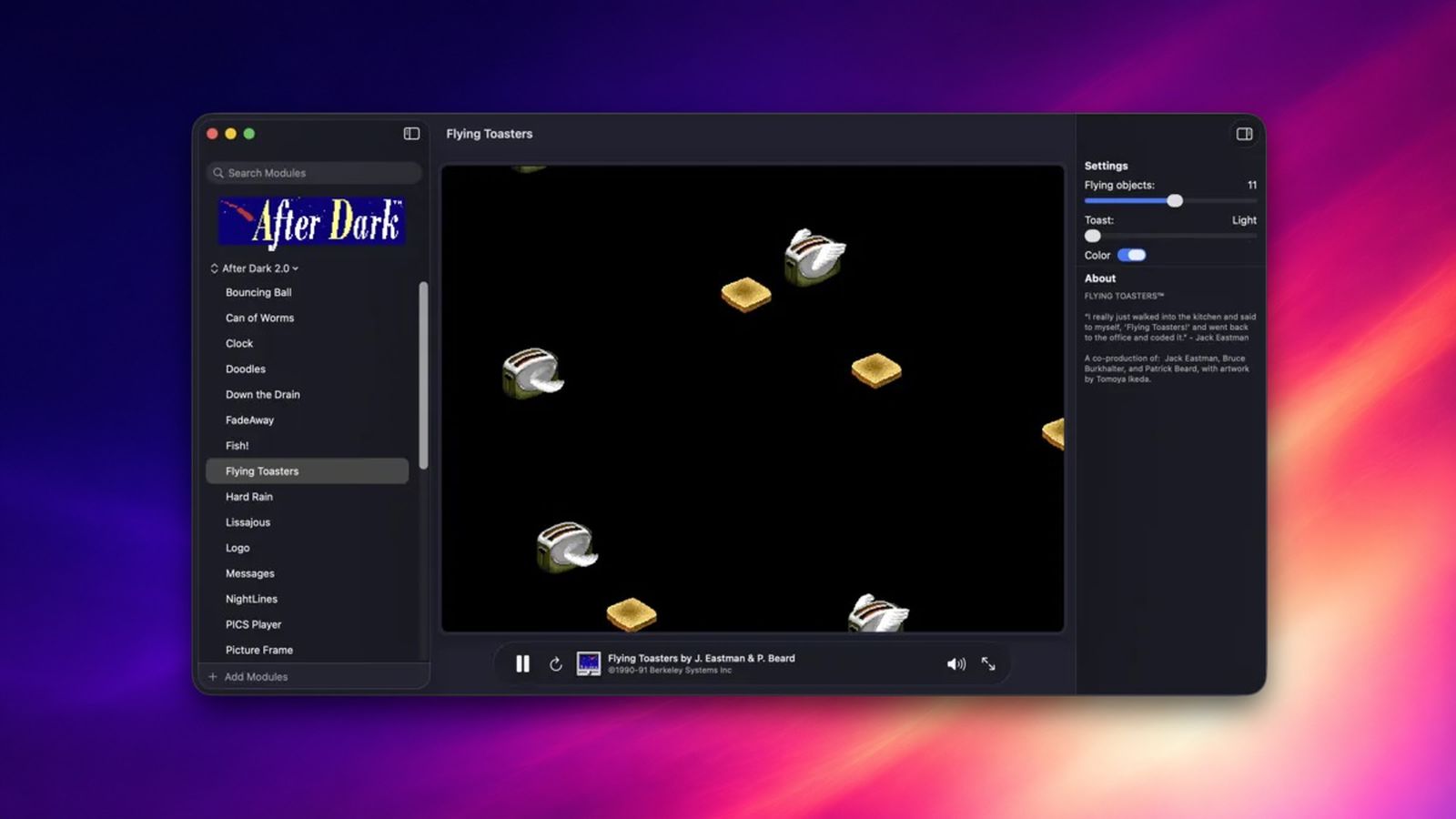
Developer Jeff Halter has released a groundbreaking new application, Afterglow, that resurrects the beloved and iconic After Dark screen savers for use on contemporary macOS operating systems. This innovative software acts as an emulator, meticulously designed to run original After Dark module code without requiring any dependencies on obsolete ROMs or classic Mac OS environments. The announcement, first highlighted by John Gruber on Daring Fireball, has generated considerable excitement among long-time Mac users and those with a penchant for digital nostalgia.
Halter, already known for his engaging and retro-inspired digital projects such as the After Dark space shooter Lunacy and the HyperCard player Stacks, has demonstrated a consistent talent for breathing new life into vintage software experiences. Afterglow represents a significant undertaking, as it bypasses the typical challenges of porting or remaking classic software by directly emulating the original execution environment for these modules. This approach ensures a level of authenticity and fidelity that remakes often struggle to achieve, allowing users to experience the screen savers as they were originally intended, albeit on vastly more powerful and modern hardware.
The original After Dark series, developed by Berkeley Systems, was a cultural phenomenon in the late 1980s and early 1990s. It transformed the utilitarian function of a screen saver—which was primarily to prevent phosphor burn-in on CRT monitors—into a form of digital art and entertainment. Popular modules like "Flying Toasters," "Boris," "Chameleon," and "Tunnel" became instantly recognizable and were often the subject of water cooler conversations among computer users. The software was not just about preventing screen damage; it was about personalizing the computing experience and adding a touch of whimsy to the often-stark interfaces of early personal computers.
A Nostalgic Resurgence: The Appeal of After Dark
The release of Afterglow taps into a growing trend of digital preservation and retro computing. As technology rapidly advances, there’s an increasing appreciation for the software and hardware that paved the way for today’s innovations. For many who grew up with Macs in the era of the Macintosh Plus, the Macintosh SE, and the early PowerPC Macs, After Dark was a familiar and cherished part of their digital landscape. The animations, the quirky characters, and the sheer variety of modules offered a sense of personality and fun that is often missing in the more streamlined and utilitarian software of today.
The technical achievement behind Afterglow is notable. Emulating original 68k module code means that Halter has had to reverse-engineer or understand the execution context in which these modules operated. This is a far more complex task than simply rewriting the visual elements of a screen saver. It involves simulating the processor, memory management, and graphics routines that the original After Dark software relied upon. The fact that Afterglow achieves this without dependencies on ROMs or classic Mac OS signifies a sophisticated understanding of the underlying architecture and a masterful application of emulation techniques.
The Technical Underpinnings of Afterglow
Jeff Halter’s description of Afterglow as an "emulator built specifically for running After Dark modules" is key to understanding its significance. Unlike a simple port or a modern reinterpretation, Afterglow aims to provide an environment where the original, unmodified After Dark modules can execute. This means that the visual fidelity, the timing of animations, and the overall behavior of the screen savers should be remarkably close to their original incarnations. This approach is particularly appealing to purists who value authenticity in their retro computing experiences.
The implications of this are far-reaching for enthusiasts. It opens up the possibility of experiencing a vast library of After Dark modules, many of which might have been lost to time or are difficult to find and run on modern systems. The After Dark franchise was extensive, with numerous expansion packs and third-party modules released over the years. Afterglow could potentially unlock access to a significant portion of this digital heritage.
A Chronology of Screen Savers and Digital Preservation
The concept of the screen saver emerged in the early days of computing, driven by the limitations of CRT (Cathode Ray Tube) technology. Phosphor coatings on these screens could retain an image if the same static graphic was displayed for extended periods, leading to "burn-in." Early solutions were rudimentary, often involving a black screen or simple animations.
- 1980s: The rise of personal computers saw the development of more sophisticated screen savers. Berkeley Systems, founded in 1987, became synonymous with After Dark, which was first released in 1989. Its popularity exploded throughout the early 1990s, becoming a staple on countless Macintosh computers.
- 1990s: Other notable screen savers of the era included Intermission and After Dark competitors on the Windows platform. The focus remained on preventing screen burn-in, but the entertainment and personalization aspects grew in importance.
- 2000s: With the advent of LCD and LED displays, the need for screen savers to prevent burn-in diminished significantly. Modern displays are far less susceptible to this issue. Consequently, screen savers transitioned primarily to a feature for privacy (e.g., requiring a password upon resume) or aesthetic appeal. Apple’s macOS transitioned to a more modern approach with features like its built-in screen saver gallery and the ability to use photos or various abstract animations.
- 2010s – Present: A growing interest in digital preservation and retro computing has emerged. Enthusiasts seek to experience and maintain software from past eras. Projects focused on emulating classic hardware and software, or creating compatibility layers, have gained traction. Jeff Halter’s Afterglow is a prime example of this contemporary movement, focusing on a specific and beloved piece of digital history.
Supporting Data and Context
The original After Dark software was incredibly successful. While precise sales figures from Berkeley Systems are not readily available, its widespread adoption and cultural impact suggest millions of users. It was bundled with many Macintosh computers and sold as a standalone product. The franchise spawned sequels and spin-offs, including More After Dark, After Dark 3, and even games based on its characters. The "Flying Toasters" module, in particular, became an enduring icon, representing a playful and innovative approach to software design.
The technical specifications of the original After Dark modules were designed for the hardware of the late 1980s and early 1990s. These modules typically ran on 680×0 processors and utilized the classic Mac OS graphics and event handling systems. For Afterglow to run these modules on modern Macs, which feature Intel or Apple Silicon processors and run macOS versions that have long since dropped support for the classic OS, Halter’s emulator has to bridge a significant technological gap. This involves translating the instructions and calls made by the original code into a format that modern macOS can understand and execute.
Reactions and Potential Implications
The release of Afterglow has been met with widespread enthusiasm within the Mac enthusiast community. Online forums and social media platforms are abuzz with discussions about the app. Many users express a deep sense of nostalgia and are eager to re-experience these classic screen savers.
"It’s incredible to see the ‘Flying Toasters’ animated again on my M2 Mac," commented one user on a popular Mac enthusiast forum. "I haven’t seen them in over twenty years, and it’s exactly as I remember it. Halter has done an amazing job."
Another user highlighted the preservation aspect: "This isn’t just about nostalgia; it’s about preserving a piece of computing history. So many of these classic modules are lost or inaccessible. Afterglow makes them available to a new generation and ensures they aren’t forgotten."
From a broader perspective, the success of Afterglow could inspire further development in the field of retro software emulation. As more developers tackle the challenge of bringing legacy applications to modern platforms, users can gain access to a richer digital heritage. This has implications not only for entertainment and nostalgia but also for historical research, software archaeology, and even the potential for discovering forgotten functionalities or artistic expressions within older software.
The Future of Digital Nostalgia
Jeff Halter’s Afterglow is more than just an app; it’s a bridge to the past, a testament to the enduring appeal of classic digital experiences, and a significant contribution to the ongoing effort of digital preservation. By allowing users to run original After Dark modules on modern macOS, Halter has provided a unique and authentic way to reconnect with a cherished era of personal computing. The success and reception of Afterglow suggest a strong market and interest for such ventures, potentially paving the way for more developers to explore and revive other forgotten gems of the digital age. The "Flying Toasters" and their animated companions are once again gracing our screens, not as a functional necessity for CRT monitors, but as a delightful reminder of the creativity and charm that once defined our digital environments. This release underscores that the digital past is not just a collection of obsolete files but a living, breathing part of our technological narrative that can be actively engaged with and appreciated in the present.