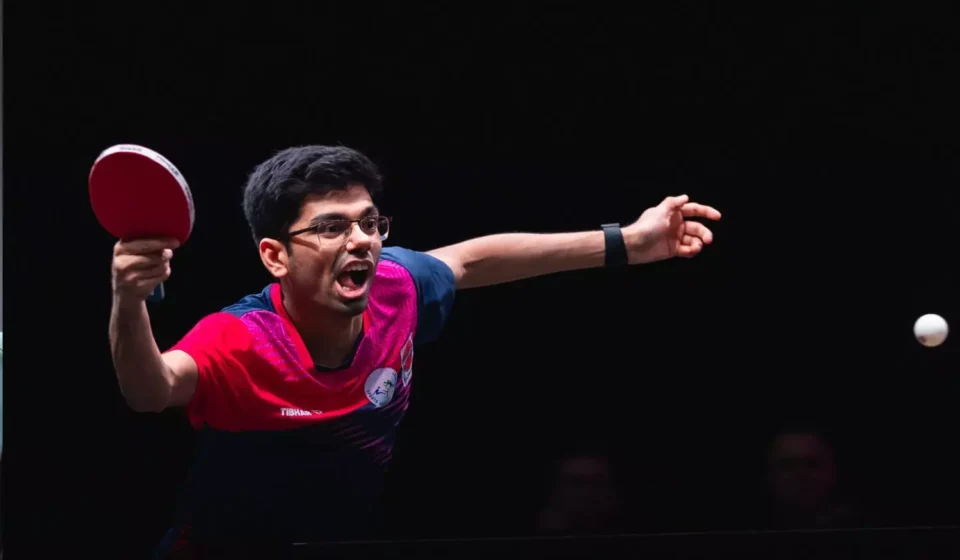
Indian Campaign Concludes Early at 2026 WTT Champions Chongqing Following Opening Round Defeats for Thakkar and Akula

The 2026 World Table Tennis (WTT) Champions Chongqing witnessed an unexpectedly swift conclusion for the Indian contingent as both Manav Thakkar and Sreeja Akula were eliminated in the opening round of the prestigious tournament. Held in the high-octane atmosphere of Chongqing, China, the event serves as a critical juncture in the international table tennis calendar, featuring the world’s top 32 players. However, for India’s representatives, the campaign was marred by a combination of formidable opposition, logistical hurdles, and the lingering effects of physical recovery. Manav Thakkar, India’s highest-ranked male paddler in the draw, found himself unable to overcome the clinical efficiency of Germany’s Dang Qiu, while Sreeja Akula’s valiant return to the international stage after injury was cut short by a resilient performance from Welsh wildcard Anna Hursey.
Tactical Breakdown: Manav Thakkar vs. Dang Qiu
The men’s singles opening round featured a high-stakes encounter between Manav Thakkar and the World No. 12, Dang Qiu. Thakkar, who has been a rising force in Indian table tennis, entered the match under less-than-ideal circumstances. Due to a delay in the processing of his travel visa, Thakkar arrived in Chongqing significantly later than scheduled, leaving him with minimal time to acclimate to the local conditions and the specific playing surface of the tournament.
The lack of preparation time was evident from the onset. Dang Qiu, known for his sophisticated penhold style and exceptional lateral movement, dictated the tempo of the match from the first serve. The German international utilized a combination of deep pushes and sharp, angled forehand loops to keep Thakkar on the defensive. The first game set the tone for the match, with Qiu securing a comfortable 11-6 lead.
Thakkar attempted to adjust his strategy in the second game, looking to engage Qiu in longer rallies and utilize his backhand flick to disrupt the German’s rhythm. However, Qiu’s service receive remained impeccable, preventing Thakkar from gaining any meaningful momentum. The second game concluded 11-7 in favor of the German. The third game followed a similar trajectory; despite flashes of brilliance from the Indian paddler, Qiu’s consistency proved insurmountable. The match concluded in just under 19 minutes with a final scoreline of 6-11, 7-11, 6-11.
The statistics from the match highlight the disparity in execution. Qiu recorded an 85% success rate on his first-serve points, while Thakkar struggled to convert on his own service games, winning only 48% of those points. This exit marks a significant hurdle for Thakkar, who had been aiming to break into the top tier of the WTT rankings through a deep run in Chongqing.
Resilience and Recovery: Sreeja Akula’s Hard-Fought Exit
Earlier in the week, the women’s singles draw saw Sreeja Akula face off against Anna Hursey of Wales. For Akula, this tournament was more than just a competition; it represented a major step in her comeback journey following a prolonged injury lay-off that had kept her away from the table for several months.
Facing a wildcard entrant like Anna Hursey is often a deceptive challenge. Hursey, representing Wales, entered the match with nothing to lose and a highly aggressive tactical approach. The first game was a grueling 26-point affair, characterized by intense back-and-forth rallies and tactical timeouts. Akula showed glimpses of the form that made her a Commonwealth Games standout, pushing the game to deuce. However, Hursey managed to clinch the opening set 14-12, a result that proved psychologically pivotal.
Akula responded with characteristic grit in the second game. She optimized her placement, forcing Hursey into unforced errors and taking the game 11-5 to level the match. At this stage, it appeared that the Indian paddler might find the stamina to navigate the encounter. However, as the match crossed the 20-minute mark, the physical toll of the long layoff began to surface.
The third and fourth games were tightly contested, but Hursey’s match fitness allowed her to maintain a higher intensity during the closing points of each set. Akula stayed within reach, but ultimately fell 9-11 and 8-11 in the final two games. The match lasted 32 minutes, reflecting a much more competitive struggle than the men’s singles encounter, yet the result remained the same: an early exit for India.
Chronology of the 2026 WTT Champions Chongqing Indian Campaign
The timeline of India’s involvement in the 2026 Chongqing event was characterized by administrative anxiety followed by rapid competitive outcomes:
- Pre-Tournament (48 hours prior): Reports emerged that Manav Thakkar’s participation was in jeopardy due to visa delays. While the Table Tennis Federation of India (TTFI) worked with Chinese authorities to expedite the process, the delay meant Thakkar missed several scheduled practice sessions at the match venue.
- Tuesday Morning: Sreeja Akula took to the court for the first session of the women’s singles Round of 32. Despite a strong second-game comeback, she succumbed to Anna Hursey in a four-set battle.
- Tuesday Evening: Following Akula’s exit, the pressure shifted to Manav Thakkar. Having arrived in the city only a day prior, Thakkar faced Dang Qiu in the evening session. The match was the fastest of the session, lasting less than 20 minutes.
- Wednesday: With both representatives eliminated in the first round, the Indian contention at the WTT Champions Chongqing officially concluded, leaving the coaching staff to focus on post-match analysis and recovery protocols.
Supporting Data and Ranking Implications
The WTT Champions series is restricted to the top 32 players in the world, making every match a high-stakes environment for world ranking points. The early exits of Thakkar and Akula will have tangible impacts on their standings:
- Ranking Points: Participants in the Round of 32 receive 15 world ranking points. Had either player advanced to the Round of 16, they would have secured 90 points. A quarter-final finish would have yielded 175 points. For Thakkar, who is hovering on the edge of the world’s top 20, the missed opportunity to gain substantial points may affect his seeding in upcoming WTT Star Contender events.
- Head-to-Head Records: This was the third meeting between Thakkar and Qiu on the international circuit, with the German now holding a 3-0 advantage. For Akula and Hursey, this was their first major encounter at a WTT Champions level, establishing a new rivalry in the mid-tier of the women’s rankings.
- Performance Metrics: Akula’s 32-minute match was among the longest of the first round for women’s singles, indicating that while her results are not yet back to peak levels, her competitive endurance is steadily improving post-injury.
Official Reactions and Inferred Analysis
While official statements from the players were brief, sources close to the Indian camp suggested a mix of frustration and pragmatism. For Thakkar, the primary frustration stemmed from the travel logistics. It is understood that the coaching staff viewed the visa delay as a "critical disadvantage" that prevented the player from finding his range on the specific table brand and lighting conditions used in Chongqing.
For Sreeja Akula, the focus remains on long-term health. The medical team traveling with the Indian contingent reportedly monitored her recovery closely during the 32-minute match. The consensus is that while the loss is disappointing, the fact that she competed in a high-intensity four-set match without aggravating her previous injury is a silver lining.
National coaches have emphasized that the 2026 season is a building block for the upcoming Asian Games and World Championships. The early exit in Chongqing serves as a "reality check" regarding the depth of the international field and the necessity of seamless logistical support for athletes.
Broader Impact and Future Outlook for Indian Table Tennis
The results in Chongqing highlight the current state of Indian table tennis: a sport with significant individual talent that occasionally struggles with the consistency required to dominate the "Champions" level events. Unlike "Contender" or "Feeder" series events where Indian players frequently reach the podium, the "Champions" series represents the absolute elite.
1. The Need for Logistical Precision:
The visa issue faced by Thakkar underscores a recurring problem in international sports management. For elite athletes, a 24-hour delay can be the difference between a podium finish and a first-round exit. Moving forward, the TTFI and sports ministry will likely face calls to streamline travel protocols to ensure players arrive at least 72 hours before their first match.
2. Managing the Comeback Trail:
Sreeja Akula’s situation highlights the difficulty of the WTT calendar. With events scheduled almost every fortnight, there is little room for a "grace period" for players returning from injury. Akula will need to carefully select her next few tournaments to balance ranking point needs with physical preservation.
3. The Rise of Global Competition:
The success of Anna Hursey against a seasoned player like Akula serves as a reminder that the global talent pool is expanding. Wales, traditionally not a powerhouse in table tennis, is now producing players capable of upsetting established stars from India and Asia.
4. Looking Ahead to the 2026 Season:
Despite the setbacks in Chongqing, the Indian team remains one of the most improved units globally over the last five years. The focus now shifts to the upcoming WTT Star Contender and the continental championships. For Thakkar, the priority will be a quick turnaround and finding rhythm in a more stable environment. For Akula, the goal is to convert competitive sets into match wins as her fitness returns to 100%.
In conclusion, while the 2026 WTT Champions Chongqing was a short-lived affair for India, it provides essential data points for the players and their coaching staff. The gap between India’s top paddlers and the world’s top 10 remains a challenge of both tactical execution and administrative support. As the circuit moves forward, the lessons learned in the 19 minutes of Thakkar’s match and the 32 minutes of Akula’s battle will be vital for the next phase of Indian table tennis’s global evolution.