
Louis Navellier’s Quantitative Analysis Strategy and the Evolution of Algorithmic Stock Grading Systems

The integration of advanced computational power with fundamental financial analysis has fundamentally altered the landscape of modern equity investment, transitioning from manual ledger reviews to sophisticated algorithmic modeling. At the forefront of this shift is Louis Navellier, a veteran market analyst whose proprietary "Stock Grader" system represents a decades-long synthesis of quantitative data and fundamental metrics. This methodology, which originated during the nascent era of mainframe computing, provides a structured framework for evaluating thousands of publicly traded securities through a simplified A-through-F grading scale. By focusing on the intersection of institutional buying pressure and core corporate health, the system attempts to isolate "alpha"—the ability of an investment to outperform a benchmark index like the S&P 500.
The Genesis of Quantitative Grading Systems
The historical trajectory of algorithmic investing is often traced back to the late 1970s and early 1980s, a period when access to high-level computing was restricted to academic institutions and major financial hubs. Navellier’s entry into this field was catalyzed by a graduate-level assignment designed to create a tracking error-free model of the S&P 500. Using mainframe technology, the resulting model unexpectedly identified a subset of stocks that did not merely mirror the index but consistently exceeded its returns. This discovery suggested that specific, measurable characteristics were indicative of future outperformance, leading to the formalization of the Stock Grader system.

This evolution mirrored a broader industry trend where pioneers like James Simons of Renaissance Technologies and David Shaw of D.E. Shaw began utilizing mathematical models to exploit market inefficiencies. While many of these institutional models remained "black boxes"—proprietary and opaque—the grading system developed by Navellier sought to democratize these insights for individual investors. The core philosophy rests on the belief that while markets may be efficient in the long term, short-term anomalies driven by institutional behavior and fundamental growth can be identified and exploited.
The Eight Pillars of Fundamental Analysis
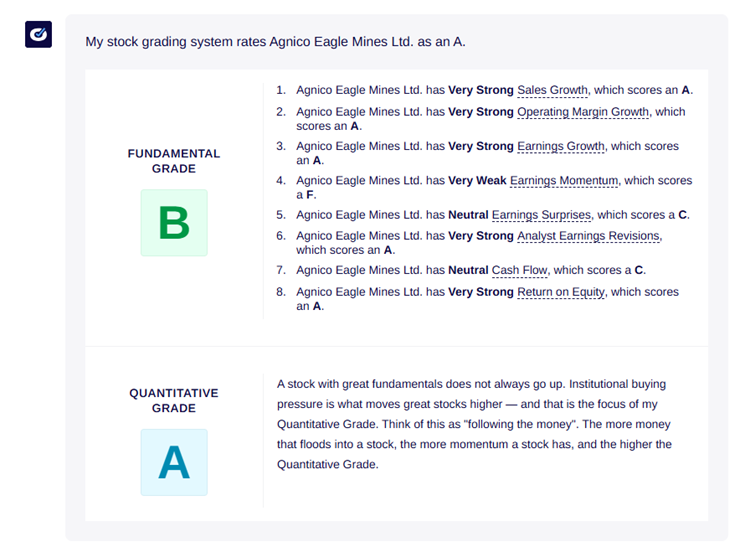
The Stock Grader system evaluates the "Fundamental Grade" of a security by analyzing eight distinct financial metrics. These factors are designed to provide a comprehensive view of a company’s operational efficiency and growth trajectory.
- Sales Growth: Recognized as one of the most transparent indicators of corporate health, sales growth measures the top-line revenue expansion. Unlike earnings, which can be subject to various accounting adjustments, revenue provides a direct look at market demand for a company’s products or services.
- Operating Margin Growth: This metric evaluates the percentage of revenue remaining after covering operating expenses. Expanding margins indicate that a company is either increasing its pricing power or achieving greater internal efficiencies, both of which are critical for long-term scalability.
- Earnings Growth: Measured as earnings per share (EPS), this factor tracks the bottom-line profitability of a firm. Consistent year-over-year growth is viewed as a prerequisite for sustainable share price appreciation.
- Earnings Momentum: Beyond simple growth, momentum measures the acceleration of that growth. A company whose earnings are increasing at a faster rate than in previous quarters often attracts significant institutional interest.
- Earnings Surprises: The "surprise" factor occurs when a company reports quarterly results that exceed the consensus estimates of Wall Street analysts. Historically, stocks that post positive surprises tend to experience a "post-earnings announcement drift," where the share price continues to rise for weeks or months following the news.
- Analyst Earnings Revisions: When professional analysts raise their future earnings estimates for a company, it serves as a signal of high-conviction confidence. These revisions often precede further institutional accumulation.
- Cash Flow: This measures the actual liquidity moving through a business relative to its market valuation. Robust cash flow allows for reinvestment, debt reduction, and shareholder returns via dividends or buybacks.
- Return on Equity (ROE): ROE measures how effectively a company’s management uses shareholder capital to generate profit. It is a primary indicator of resource management and corporate governance quality.
The Quantitative Component: Tracking "Smart Money"
While fundamentals provide the "why" behind a stock’s potential, the "Quantitative Grade" provides the "when." This component of the grading system focuses on institutional buying pressure, often referred to in financial circles as "smart money." Large-scale investors, including hedge funds, pension funds, and investment banks, move markets due to the sheer volume of their trades.
When institutional entities begin accumulating a position, it creates a "tailwind" of buying pressure that can drive prices higher regardless of retail sentiment. The Stock Grader system utilizes proprietary algorithms to detect these patterns of accumulation. A high Quantitative Grade suggests that a stock is currently being "bought into" by major players, providing the necessary momentum to realize the value suggested by its fundamental metrics. The final "Total Grade" is a weighted blend of these two categories, prioritizing stocks that possess both strong internal health and external market support.
Case Studies in Performance: From Gold to Silicon
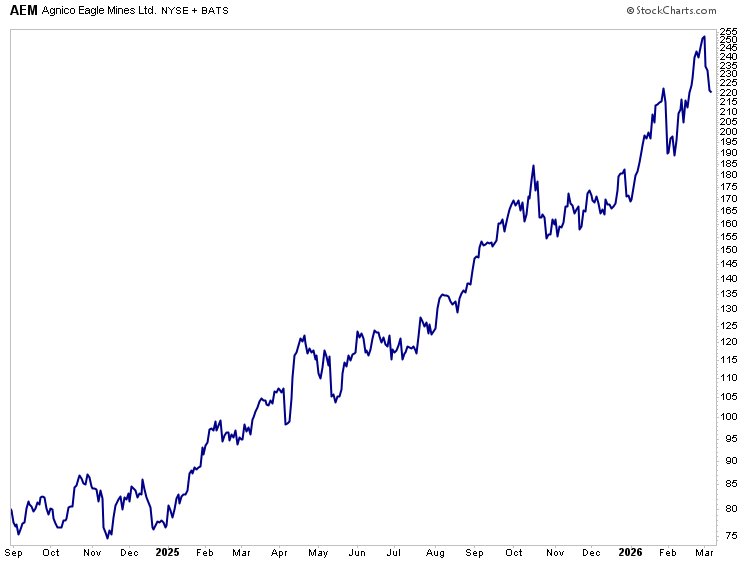
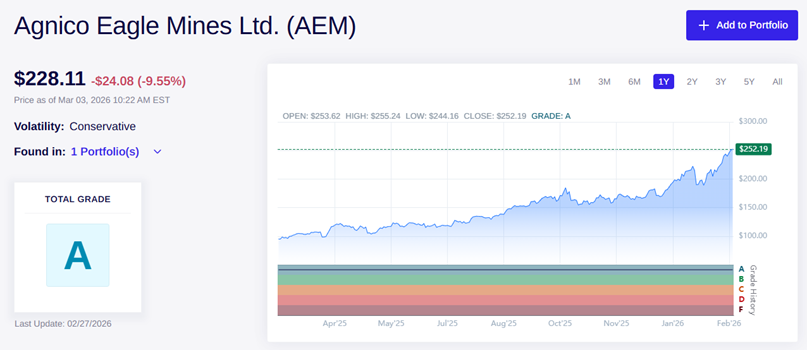
The efficacy of a dual-track grading system is often illustrated through historical performance during various market cycles. A notable contemporary example is Agnico Eagle Mines Ltd. (AEM), the world’s second-largest gold producer. In August 2024, the Stock Grader system assigned AEM a Total Grade of "A." This recommendation coincided with a period of heightened geopolitical instability and shifting central bank policies, which drove gold prices higher.
Agnico Eagle Mines benefited from "operating leverage"—a phenomenon where a company’s profits grow at a significantly faster rate than the price of the underlying commodity it produces. Because the miner’s fixed costs remain relatively stable, every dollar increase in the price of gold contributes directly to the bottom line. Following the "A" rating, subscribers to Navellier’s Growth Investor service saw gains of nearly 180%. As of early 2026, the stock maintains its "A" grade, supported by a "B" in fundamentals and an "A" in quantitative buying pressure, suggesting continued institutional favor.
Historically, the system has identified significant winners during major technological shifts. In 1998, during the early build-out of the internet, the system flagged Cisco Systems (CSCO), which subsequently rose over 200%. In 2004, it identified América Móvil (AMX) during the expansion of telecommunications in emerging markets, leading to a 370% gain. Perhaps most notably, the system issued a recommendation for NVIDIA Corporation (NVDA) in 2016, long before the company became the centerpiece of the artificial intelligence (AI) revolution. Those who followed the "A" grade at that time have seen returns exceeding 4,000%, as NVIDIA’s fundamental metrics—specifically sales growth and earnings momentum—surged alongside the global demand for data center GPUs.
The Transition from Passive to Active Strategy
A significant theme in the current investment climate is the growing debate between passive index fund investing and active quantitative management. While index funds have been the "gold standard" for retail investors for decades due to their low fees and broad exposure, critics argue that they carry inherent concentration risks. In recent years, the S&P 500 has become increasingly "top-heavy," with a handful of mega-cap technology stocks accounting for a disproportionate share of the index’s movement.
Navellier has voiced concerns regarding this trend, suggesting that traditional index funds may expose investors to "valuation bubbles" in specific sectors. The Stock Grader approach serves as an alternative, advocating for a "rules-based" active strategy. By filtering the market for only those stocks with "A" or "B" grades, investors can theoretically avoid the "laggards" that weigh down a broad index. This philosophy was put to a practical test by Navellier’s daughter, Crystal, an art student with no formal financial background. By adhering strictly to the system’s grading outputs, her portfolio reportedly outperformed the broader market by a 2-to-1 margin in the previous year, highlighting the system’s intended accessibility for non-professionals.
Broader Market Implications and Future Outlook
The rise of accessible quantitative tools like Stock Grader reflects a broader "democratization of data" within the financial industry. As computing power continues to decrease in cost and increase in capability, the gap between institutional "quants" and retail investors is narrowing. However, the reliance on historical data and algorithmic grading is not without risk. Market "black swan" events, sudden regulatory changes, or shifts in global liquidity can disrupt even the most robust models.
Nonetheless, the persistence of the Stock Grader system over several decades suggests that fundamental corporate health and institutional flow remain the primary drivers of equity valuations. For the modern investor, the challenge lies in filtering the "noise" of 24-hour financial news cycles. Systems that provide a clear, objective metric—such as a simple A-F grade—offer a psychological and analytical anchor in volatile markets. As the financial world moves further into the era of AI and big data, the integration of human-led fundamental inquiry and machine-led quantitative tracking will likely remain the cornerstone of successful growth-oriented portfolios.
The strategy emphasizes that while the tools of the trade have evolved from 1970s mainframes to modern cloud computing, the core objective remains the same: identifying high-quality companies with strong institutional backing before the broader market fully prices in their potential. In an environment where index concentration is at historic highs, the move toward selective, grade-based investing represents a significant shift in how individuals approach long-term wealth preservation and growth.