
Studio Bside, known for its critically acclaimed strategic RPG CounterSide, has launched its latest mobile title, StarSavior, an ambitious role-playing experience that invites players to guide a roster of "Savior" characters through cosmic journeys to harness the formidable power of the StarSavior. The game draws inspiration from successful genre predecessors such as Umamusume Pretty Derby, Eversoul, and Outerplanes, aiming to forge a distinctive blend of strategic combat, narrative depth, and character-centric progression. This comprehensive analysis delves into StarSavior‘s multifaceted design, evaluating its technical performance, gameplay intricacies, content offerings, economic model, and overall standing within the burgeoning mobile RPG market.
Foundation and Initial Impressions: A Deep Dive into StarSavior‘s Core
At its heart, StarSavior positions players as leaders of the Saviors, tasked with navigating a vast cosmos and uncovering the secrets behind the titular StarSavior’s power. The game’s premise, while featuring elements familiar to the genre—such as an amnesiac protagonist and a quest for lost abilities—endeavors to craft a unique narrative tapestry. Initial engagement with the title reveals a deliberate synthesis of diverse mechanics: the tactical depth of turn-based combat, the unpredictable progression of roguelike elements, and the passive resource generation typical of idle games. This hybrid approach seeks to appeal to a broad spectrum of players, from those who relish intricate battle strategies to those who prefer a more relaxed, long-term progression loop.
A significant period of hands-on evaluation, exceeding 26 hours, was undertaken on a standard mid-range mobile device, a Samsung M55. This choice of hardware aimed to provide a realistic assessment of the game’s accessibility and performance across a common user demographic, ensuring that the findings reflect the experience of a typical mobile gamer rather than one utilizing high-end, specialized hardware. The subsequent breakdown examines critical facets including optimization, graphical fidelity, user interface design, audio production, narrative development, and the overarching monetization strategies. Prospective players are also advised that resources such as redeem code guides, Savior tier lists, and reroll guides are available to optimize their early game experience, a common practice in the gacha genre to facilitate smoother onboarding.

Gameplay Dynamics: A Strategic Nexus of Combat, Roguelike, and Idle Systems
The core combat system in StarSavior is a sophisticated turn-based affair, bearing resemblances to the strategic depth found in titles like Honkai Star Rail and Outerplanes. However, StarSavior leans more heavily into Outerplanes‘ model, emphasizing counter-attacking strategies and a strong focus on PvP-centric game modes. Unit speed plays a pivotal role, determining the initiative in battle order, a mechanic that adds a crucial layer of tactical foresight. The "breaking" mechanism, which temporarily incapacitates enemies and grants a favored turn to a non-stunned allied unit, is well-balanced, contributing to dynamic combat scenarios that reward careful planning and team composition.
Unlike Honkai Star Rail, where character progression is primarily achieved through farming specific resource nodes, StarSavior integrates a substantial idle resource collection system, reminiscent of AFK Journey and Eversoul. This passive accumulation of resources is crucial for character development, although traditional farming nodes exist, their utility is constrained by a "Willpower" stamina system, which imposes a daily limit of 240 points. This dual-pronged approach to resource acquisition necessitates a strategic allocation of active play time and an understanding of the long-term benefits of idle progression.
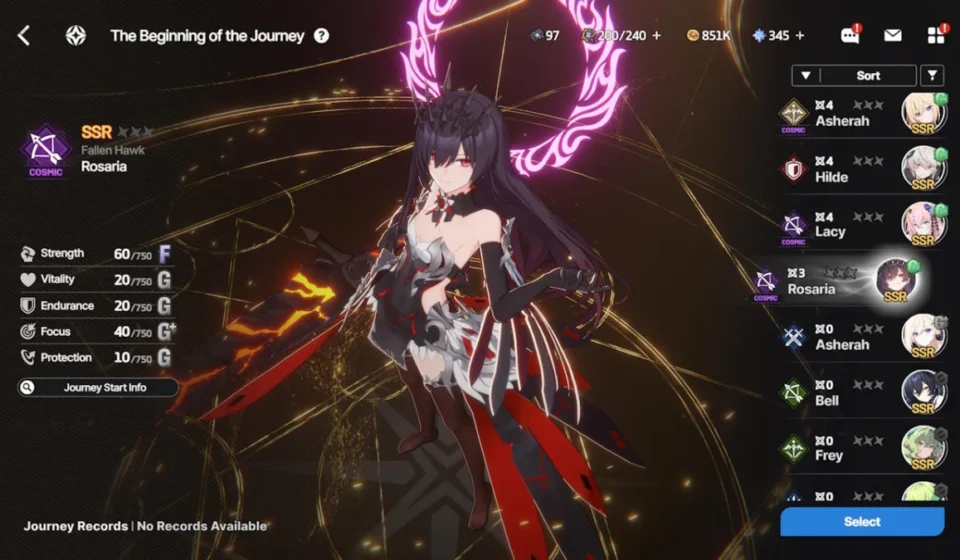
A standout feature is the "Journey" system, StarSavior‘s equivalent of a character career mode, drawing direct inspiration from Umamusume Pretty Derby. In this mode, players select a specific Savior and guide them through a comprehensive career playthrough designed to enhance their stats and unlock unique abilities. The Journey functions as a distinct roguelike experience, offering procedural elements and strategic choices that impact a Savior’s development. Currently, the mode features three difficulty levels, with two locked behind mid-to-late game progression milestones. While the roguelike implementation is engaging, the overall length of each Journey run is comparatively shorter than the expansive career options available in Umamusume, potentially limiting its long-term replayability for some players. Success in the Journey mode, particularly on higher difficulties, is heavily reliant on the acquisition and strategic deployment of "Arcanas," which serve as the game’s variant of support cards, similar to those found in Umamusume. Achieving high scores (e.g., 4300 out of a possible 4500 points on easy mode) mandates a well-curated selection of Arcanas, underscoring the importance of meta-knowledge and optimal card usage.
The strategic depth of StarSavior truly manifests at the skill ceiling, which players encounter after maximizing their Saviors and clearing available game modes. A critical piece of advice for players aiming for efficiency is to avoid fully leveling up units that lack maximum Limit Break (LLB), as this can quickly deplete precious resources without yielding proportionate returns. The competitive landscape of PvP modes necessitates the acquisition and development of S-tier units to achieve significant progress. This emphasis on top-tier characters for competitive play highlights a potential pressure point for free-to-play users, who may find themselves at a disadvantage against players with extensive rosters of fully optimized units.

Expansive Game Modes and Content Diversity: A Healthy Ecosystem
StarSavior boasts a robust array of game modes, designed to provide a continuous stream of engagement and progression opportunities. Beyond the aforementioned Journey mode, the game features a comprehensive story campaign currently spanning five episodes, offering a rich narrative experience. An endless tower mode challenges players to clear progressively difficult stages across four elemental types, providing a consistent test of team strength and tactical prowess. Further content includes an endless progression stage, five distinct resource hunting modes for specialized material acquisition, a permanent boss raid mode with seasonal rotations for ongoing challenges, and a multifaceted PvP system. The PvP modes offer both real-time matchmaking against other players and the option to battle against pre-selected defensive teams, catering to different competitive preferences.
The sheer volume of content ensures that players will find ample opportunities for progression and challenge. Even after significant playtime, the reviewer noted that only the normal difficulty for Journey mode had been unlocked, indicating a substantial amount of endgame content remaining to be explored. This extensive content pipeline assuages concerns regarding potential content droughts, a common issue in live-service mobile games. Furthermore, the efficient design of daily routines, which can be completed in approximately five minutes, allows StarSavior to function effectively as a "side gacha" title. This low daily time commitment makes it an attractive option for players who wish to engage with a compelling RPG without dedicating extensive hours each day, enabling them to pursue Savior stories at their own pace.
Visuals and Optimization: Balancing Aesthetics with Accessibility
For Studio Bside’s inaugural foray into 3D gacha game development, StarSavior demonstrates a surprising degree of polish and optimization. The quality of the 3D character models is commendable, showcasing a level of detail that, while not groundbreaking, is certainly respectable for the mobile platform. The game maintains a smooth 60 frames per second (fps) on high settings during mid-battle sequences, even on a mid-range device like the Samsung M55, indicating effective optimization that prioritizes a fluid gameplay experience. This performance stability is a significant positive, ensuring that a wide audience can enjoy the game without encountering major technical hurdles.

In terms of visual fidelity, StarSavior‘s aesthetic quality can be broadly compared to Honkai Star Rail. While it does not aspire to the hyper-realistic or cutting-edge graphical benchmarks set by titles such as Arknights Endfield or Zenless Zone Zero, it delivers a visually appealing experience that does not tax device hardware excessively. The character designs, a fusion of influences from Honkai Star Rail and Outerplanes, contribute to a distinct visual identity within the genre. The developers have successfully struck a balance between graphical ambition and practical optimization, ensuring a visually satisfying experience that remains accessible to a wide range of mobile devices.
User Interface and Controls: Exemplary Design and Intuitive Interaction
The user interface (UI) and control scheme of StarSavior stand out as particularly strong elements, earning high praise for their intuitive design and seamless functionality. Drawing parallels to the minimalist yet effective UI of Arknights Endfield, StarSavior‘s interface is remarkably well-crafted. It avoids the common pitfalls of clutter and confusion often found in complex mobile RPGs, presenting information clearly and concisely. The interactive nature of the UI elements, coupled with smooth transitions and responsive feedback, contributes to an overall premium feel. Crucially, text scaling is well-implemented, ensuring readability across various screen sizes.
In a market saturated with gacha games that often feature derivative or cumbersome interfaces, StarSavior‘s UI provides a refreshing experience. Every interaction feels deliberate and polished, devoid of the "cheap" or "mimetic" qualities that can detract from a game’s presentation. The immediate feedback provided during turn-based battles, particularly in PvP scenarios where a timer adds pressure, is precisely calibrated, alleviating potential frustrations associated with delayed touch responses. This meticulous attention to UI/UX design significantly enhances the player experience, making navigation and interaction within the game fluid and enjoyable.
Monetization, Currency, and Battle Pass: A Double-Edged Sword

The monetization model in StarSavior presents a mixed bag, characterized by both player-friendly elements and aspects that lean towards a pay-to-win (P2W) structure, particularly in competitive modes. The game operates with two primary currencies: a premium currency, Stellagems, and a free-to-play currency. A single pull in the gacha system costs 200 Stellagems, with a 10x pull priced at 2000 Stellagems. The gacha rate, at a 2% drop rate for desirable units, is considered average for the genre. While the game features numerous pop-up offers tied to leveling milestones, these are largely avoidable and do not aggressively impede gameplay.
A notable and somewhat unconventional aspect of StarSavior‘s monetization is the presence of seven distinct battle passes. Four of these are permanent, offering Stellagems based on general progression, while the remaining three are character-leveling-focused. A significant positive is that all battle passes include free-to-play progression bars, allowing non-spending players to earn rewards. Moreover, many of these rewards can be acquired within a single week through consistent idle collection, mitigating the feeling of being locked out of valuable resources without payment.
However, the game’s heavy emphasis on PvP introduces a critical imbalance. The cross-play functionality, which integrates the global server with established Japanese (JP) and Korean (KR) servers, creates a highly competitive environment where veteran players from older regions, with 4 to 6 months of progression advantage, possess significantly more developed rosters. In such a scenario, even highly skilled and fortunate free-to-play players are likely to be outmatched by "whales" who have invested heavily to maximize their units and Arcanas. This structural disadvantage means that achieving top ranks in PvP almost necessitates substantial financial investment to catch up to the power levels of established players. Consequently, while StarSavior can be enjoyed by free-to-play users for its narrative and PvE content, its competitive ecosystem strongly favors those willing to spend. Players seeking a purely casual experience or focusing on character stories will find the monetization less intrusive, but those with competitive aspirations will face a significant barrier.
Narrative Depth and Auditory Excellence: An Engaging Universe
The narrative of StarSavior places players in the shoes of an amnesiac Main Character, a common trope in RPGs, yet one that here is given some initial depth regarding their past. The protagonist serves as a guiding force for other Saviors, aiding them through their individual journeys—a concept reminiscent of Eversoul and Umamusume. However, StarSavior introduces distinct elements, such as the player character being "isekaid" into the StarSavior world, and a central plot point revolving around a quest to reclaim lost and sealed ancient power.

The story progressively reveals the protagonist’s identity and their connection to a time loop, promising a rich tapestry of interwoven past and future events. Intriguing collaboration story hints further suggest that the StarSavior universe exists as a separate dimension from the CounterSide universe, laying the groundwork for potential cross-over narratives and expanding the established lore of Studio Bside’s titles. While the story is not hailed as a groundbreaking masterpiece, it is described as decent and possesses its own compelling moments, preventing it from being merely forgettable.
Where StarSavior truly excels is in its auditory presentation. Studio Bside has a well-established reputation for outstanding music, exemplified by the acclaimed original soundtracks of CounterSide, and StarSavior continues this legacy with an array of stellar musical compositions and OSTs. The sound design extends beyond just music, with well-crafted attack sound effects (SFX) that add significant impact and immersion to combat sequences. The overall audio experience is a consistent highlight, elevating the game’s presentation and contributing significantly to its atmosphere.
Final Verdict and Market Positioning
StarSavior represents Studio Bside’s earnest attempt to innovate within the saturated mobile RPG market by integrating a diverse set of gameplay mechanics. Its unique blend of turn-based combat, roguelike progression, and idle resource management, coupled with a commendable UI and stellar audio design, carves out a distinct niche. The game’s extensive content variety ensures long-term engagement for players, and its efficient daily grind makes it an ideal "side gacha" title for those seeking a less time-intensive commitment.
However, the fierce competition in the mobile gaming sector, coupled with StarSavior‘s monetization model that heavily favors spending in its PvP components, presents significant challenges. The cross-server play with established JP and KR communities creates a substantial hurdle for new global players aiming for competitive success, potentially relegating them to a more casual, story-focused experience unless they are willing to invest heavily. While the visuals are well-optimized and aesthetically pleasing for a mobile title, they may not meet the highest expectations of players accustomed to more graphically ambitious releases.

Ultimately, StarSavior is a well-rounded offering that delivers a polished and engaging experience, particularly for fans of tactical RPGs and those who appreciate strong narrative and audio elements. It provides a refreshing alternative for players who might be seeking a departure from established titles like Eversoul and Outerplane. While its competitive integrity is somewhat compromised by its monetization and cross-server dynamics, the game’s core mechanics, diverse content, and technical polish make it a worthy contender in the mobile RPG landscape, particularly for players who prioritize strategic depth and a compelling universe over top-tier PvP rankings without significant investment.
Overall Assessment:
- Gameplay Mechanics: 7/10 – A strong blend of turn-based, roguelike, and idle, but with a high skill ceiling and PvP emphasis on top-tier units.
- Storyline and Content: 8/10 – Engaging narrative with a unique premise and robust content offerings.
- Graphics and Music: 8/10 – Solid visuals and exceptional audio design.
- Controls and UI: 8/10 – Exemplary, intuitive, and polished user experience.
- Free-to-play elements: 6.5/10 – Generous with F2P battle pass progression, but PvP significantly skewed towards spenders due to cross-server play.
Final Score: 7.5/10 (Good)
StarSavior successfully delivers a unique blend of turn-based combat, roguelike progression, and idle mechanics, enveloped within a competently polished experience. While its graphical ambition and monetization model present areas for potential refinement, the breadth of game modes and the smooth, engaging gameplay loop ensure a satisfying and enduring experience for a broad player base.