

The S&P 500 index has once again ascended into record-breaking territory, reclaiming and surpassing the all-time highs established earlier in the year. This resurgence comes on the heels of a brief but sharp market correction triggered by escalating geopolitical tensions in the Middle East, specifically involving direct military exchanges between Iran and Israel. While the swift recovery has rewarded disciplined investors who maintained their positions or increased exposure during the dip, the return to peak valuations has reignited a critical debate among economists and market strategists: does this new milestone reflect a fundamental strengthening of the economy, or is it a precarious peak that ignores mounting systemic risks?
As of the current trading week, the benchmark index is building on its momentum, driven largely by resilient corporate earnings and a continued fervor for artificial intelligence (AI) integration across the technology sector. However, the landscape has shifted significantly since the previous highs of January. Investors are now navigating a complex environment characterized by "higher-for-longer" interest rate expectations from the Federal Reserve, persistent inflationary pressures in the services sector, and a geopolitical map that remains highly volatile. The central question facing the market is whether these record prices have sufficiently accounted for these variables, or if the market is entering a phase of "irrational exuberance" similar to previous historical peaks.
The CAPE Ratio and the Historical Reality of High Valuations
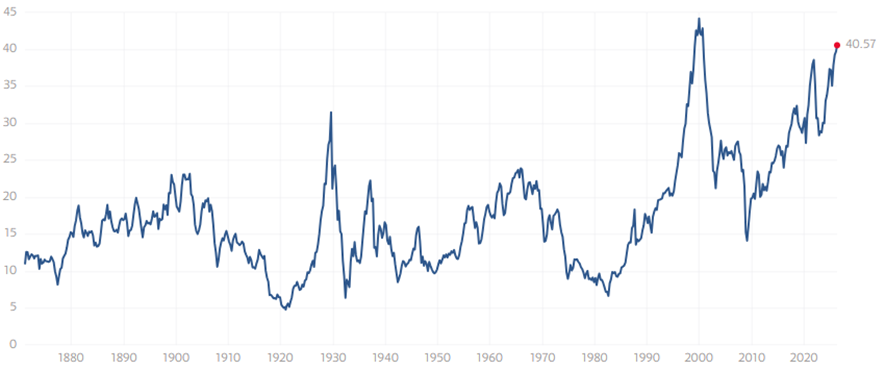
To assess the sustainability of the current rally, analysts often turn to the Cyclically Adjusted Price-to-Earnings (CAPE) ratio, also known as the Shiller P/E ratio. Developed by Nobel laureate and Yale University professor Robert Shiller, this metric provides a more comprehensive view than standard P/E ratios by measuring stock prices against the average of ten years of inflation-adjusted earnings. This smoothing effect accounts for the natural fluctuations of the business cycle, offering a clearer picture of long-term valuation trends.
Current data indicates that the CAPE ratio for the S&P 500 has climbed to approximately 41. To put this figure in historical context, this represents the second-highest reading in more than 140 years of American market history. The only period during which valuations were higher was the peak of the dot-com bubble in the late 1990s, just prior to a multi-year market collapse. For comparison, the historical mean for the CAPE ratio is approximately 17, suggesting that today’s investors are paying a significant premium for every dollar of corporate profit.
The implications of an elevated CAPE ratio are rarely immediate but are historically predictive of long-term outcomes. Analysis of market data since 1871 demonstrates a clear inverse correlation between starting valuations and subsequent 10-year real returns. When the CAPE ratio exceeds 35, the annualized real returns over the following decade have historically clustered between 0% and 5%, with several instances of negative real returns. A 2024 academic working paper titled "Estimating Long-Term Expected Returns," authored by researchers at La Trobe, Massey, and Auckland University of Technology, corroborated these findings. The study utilized an enhanced version of the CAPE ratio to conclude that starting valuations remain one of the most reliable predictors of long-term investment success, explaining a substantial portion of variance in 10-year performance.
Assessing the "This Time is Different" Narrative
Whenever valuation metrics reach extreme levels, market participants often argue that traditional measurements are no longer applicable due to structural changes in the economy. In the current cycle, proponents of higher valuations point to several factors: the dominance of high-margin technology companies, changes in corporate accounting standards regarding intangible assets, and a structural shift toward higher productivity driven by automation and AI.

Research Affiliates, a prominent investment management firm, has conducted extensive analysis into these "new era" arguments. Their findings suggest that while some factors—such as lower corporate tax rates and the asset-light nature of modern software companies—justify a modestly higher equilibrium for valuations compared to the 20th-century average, they do not fully account for a CAPE ratio of 40. The firm’s analysis highlights a fundamental mathematical reality: even if high valuations do not lead to a catastrophic crash, they inevitably "pull forward" future returns. By paying a premium today, investors are essentially borrowing gains from the future, leaving less room for capital appreciation over the long term.
The Dilemma of Timing and Momentum
Despite the warning signs from valuation metrics, the CAPE ratio has proven to be an ineffective tool for short-term market timing. For instance, the ratio signaled that the market was overvalued as early as 2018; however, investors who exited the market based on that signal would have missed one of the most powerful bull runs in history, fueled by massive fiscal stimulus and a technological revolution.
This creates a strategic dilemma for modern investors. On one side, the momentum is undeniably bullish, and the "fear of missing out" (FOMO) is once again a driving force in retail and institutional flows. On the other side, the historical data regarding forward returns at these levels suggests that the risk-to-reward profile is increasingly unfavorable for long-term buy-and-hold strategies.
The current market environment requires a departure from broad-market assumptions. As the S&P 500 becomes increasingly concentrated in a handful of mega-cap technology stocks, the performance of the "average" stock often diverges from the headline index. This divergence creates an environment where tactical, data-driven approaches may offer a way to participate in the rally while mitigating the risks associated with overextended valuations.
The Rise of Quantitative and AI-Driven Signaling
In response to these valuation challenges, many investors are turning toward quantitative research and algorithmic signaling. Unlike fundamental analysis, which relies on earnings forecasts and economic narratives, quantitative systems focus on identifying specific statistical anomalies and historical patterns that precede price movements.
TradeSmith, a quantitative research firm with a two-decade track record, has been at the forefront of developing tools that translate complex hedge-fund-level analytics for individual investors. Their latest development involves an AI-powered system designed to bypass traditional financial metrics like balance sheets and earnings reports. Instead, the system analyzes millions of data points to identify "signals"—short-term patterns that have a high historical probability of repeating.
According to TradeSmith CEO Keith Kaplan, the system performs over 800 individual calculations on thousands of stocks daily. The goal is to identify moments when the mathematical odds of a specific price move are heavily tilted in the investor’s favor, regardless of the broader market’s valuation.
Case Studies in Algorithmic Precision
The efficacy of these signals can be seen in recent market movements involving prominent equities. For example, the system recently flagged a signal for Palantir Technologies Inc. (PLTR), predicting a 5.8% move within a nine-day window based on a 95% historical accuracy rate for that specific setup. The actual outcome resulted in a 15.1% gain in just seven days, significantly exceeding the forecasted return.
Another instance involved Lam Research Corp. (LRCX), where a signal was triggered by a specific combination of technical and calendar-based factors. The system identified a pattern where the stock closed above its 200-day moving average exactly two trading days before a market holiday. When this signal fired on August 28, 2025 (looking ahead to Labor Day), the stock realized an 11.4% gain within 15 days.
These examples illustrate a shift in strategy from "predicting the market" to "identifying the signal." In an overvalued market, finding these isolated pockets of high-probability opportunity allows investors to remain active without being fully exposed to a potential systemic re-rating of the S&P 500.
Upcoming Event: Navigating the AI Signal Frontier
To address the growing demand for these alternative strategies, TradeSmith has announced a specialized "AI Signals Trading Event" scheduled for Wednesday, April 22, at 10 a.m. Eastern. CEO Keith Kaplan will lead the session, providing an in-depth look at how the firm’s proprietary AI identifies trade setups in both bull and bear market conditions.
The event aims to demystify the "black box" of algorithmic trading, showing how investors can use these tools to augment their existing portfolios. Ahead of the event, TradeSmith has opened access to a working version of their platform, allowing participants to search for active signals and test the system’s interface in real-time. This transparency is intended to provide a practical counterpoint to the abstract fears of market overvaluation, offering a tactical path forward for those wary of current price levels.
Conclusion: Strategic Vigilance in a Record Market
The return of the S&P 500 to record territory is a testament to the resilience of the American economy and the transformative potential of new technologies. However, history serves as a stern reminder that record highs are often accompanied by record risks. With the CAPE ratio at levels rarely seen in over a century, the margin for error has narrowed significantly.
For the modern investor, the path forward involves a balance of participation and protection. While exiting the market entirely has historically been a losing proposition, blind optimism in the face of extreme valuations can be equally damaging. By incorporating data-driven signals and maintaining a focus on specific, high-probability opportunities, investors can navigate this period of record-setting uncertainty with a greater degree of precision and confidence. The upcoming discussions led by industry experts like Kaplan will likely play a pivotal role in shaping how retail and institutional investors alike manage their exposure in the volatile months ahead.