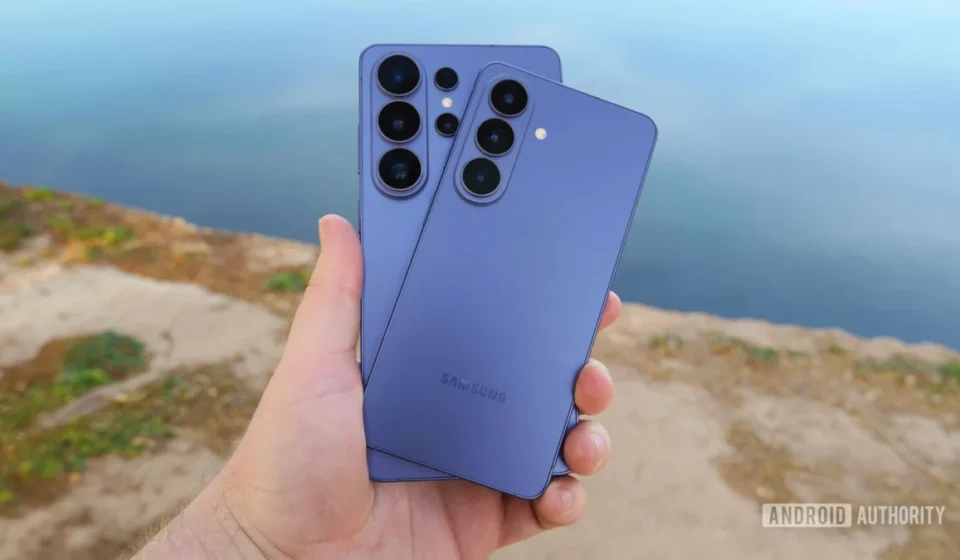
Samsung’s Exynos Processors: A Decisive Comeback Attempt Under Scrutiny for the Galaxy S26 and Beyond

Samsung’s ambitious endeavor into custom silicon for its flagship smartphones, epitomized by its Exynos line of processors, has been anything but a smooth journey. Marked by manufacturing complexities, strategic design pivots, and multiple periods of re-evaluation, the South Korean technology giant is now poised to reassert Exynos’s prominence. This renewed commitment culminates in its planned return to the global flagship lineup with the Galaxy S26, signaling a pivotal moment for the company’s in-house chip division and its global customer base. The strategic implications of this resurgence extend beyond mere hardware specifications, touching upon supply chain resilience, competitive positioning against rivals like Qualcomm and MediaTek, and the overarching brand perception of Samsung’s premium devices.
A Tumultuous Decade: The Historical Context of Exynos Challenges
The narrative of Exynos over the past decade is one of persistent struggle and fluctuating fortunes. Initially conceived to give Samsung greater control over its device ecosystem and differentiate its offerings, Exynos chips frequently found themselves in a difficult comparison with Qualcomm’s Snapdragon counterparts, particularly in terms of raw performance, thermal management, and power efficiency. This disparity often led to a fragmented global market, where consumers in certain regions received Snapdragon-powered Galaxy S devices, while others received Exynos versions, often perceived as the less superior option.
The performance inconsistencies peaked around the Galaxy S20 and S21 generations, leading to widespread consumer dissatisfaction and a significant public relations challenge for Samsung. Reports of overheating, battery drain, and inferior gaming performance became common refrains. These issues culminated in a drastic decision for the Galaxy S23 series, which entirely eschewed Exynos, opting exclusively for Qualcomm’s Snapdragon 8 Gen 2 for Galaxy across all markets. This move was a tacit acknowledgment of Exynos’s struggles and Qualcomm’s undeniable lead.
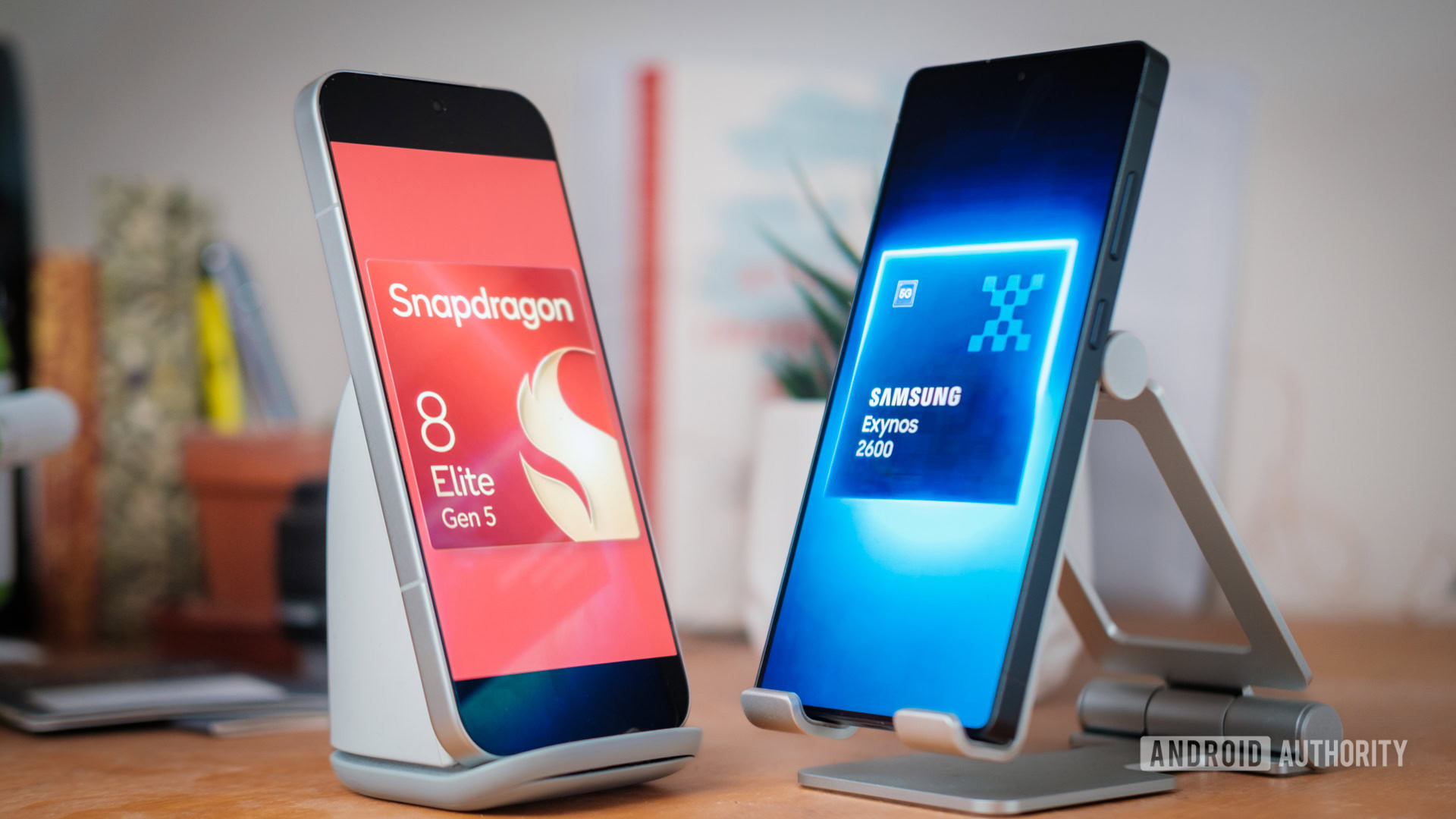
The subsequent Galaxy S24 series saw a partial return of Exynos, with the Exynos 2400 powering some base models, but the top-tier Galaxy S24 Ultra remained exclusively Snapdragon-equipped. This decision was largely influenced by Qualcomm’s significant advancements with its Snapdragon 8 Elite architecture and, reportedly, Samsung Foundry’s challenges with achieving satisfactory yields on its cutting-edge 3nm process node, which would have been critical for Exynos’s competitiveness. The Exynos 2500, another chip from this period, made a fleeting appearance in the Galaxy Z Flip 7, its limited deployment underscoring the ongoing difficulties and cautious approach by Samsung.
In response to these persistent hurdles and the strategic imperative to regain semiconductor independence, Samsung initiated a substantial restructuring of its chip design and manufacturing teams. This overhaul was not merely a cosmetic change but a fundamental re-evaluation of its approach to silicon development, with the long-term goal of revitalizing Exynos into a genuinely world-class mobile processor. This ambitious roadmap includes the long-rumored development of a custom GPU for the anticipated Exynos 2800, a move that could fundamentally alter its competitive landscape.
Strategic Reorientation: The AMD Partnership and Future Ambitions
A key element of Samsung’s strategy to bolster Exynos’s capabilities, particularly in graphics, was the formation of a strategic partnership with AMD. This collaboration, announced in 2019, aimed to integrate AMD’s RDNA graphics architecture into Samsung’s Exynos chips, replacing Arm’s Mali GPUs that had previously been used. The first fruit of this partnership, the Xclipse GPU based on RDNA architecture, debuted with the Exynos 2200 in 2022. This was a bold and calculated risk, positioning the Exynos 2200 as one of the first mobile chips to feature hardware-accelerated ray tracing, offering Samsung a distinct marketing advantage and a clear feature differentiator in the burgeoning mobile gaming segment.
The initial promise, however, proved challenging to fully realize. While the Exynos 2200 did introduce ray tracing, its overall graphics performance and efficiency were not consistently superior to its contemporary rivals, and it suffered from early driver issues that hindered optimization. Nevertheless, the partnership signified Samsung’s commitment to pushing the boundaries of mobile graphics and reducing its reliance on standard Arm IP for GPUs.
The upcoming Exynos 2800, expected to debut in the Galaxy S28, is rumored to take this commitment a step further with a fully custom GPU. This would be a significant departure from the AMD RDNA-based Xclipse, potentially indicating Samsung’s confidence in its internal design capabilities after years of collaboration with AMD. Such a move would grant Samsung even greater autonomy over its graphics architecture, allowing for deeper integration with its software ecosystem and potentially unlocking unique features tailored for Galaxy devices. This pursuit of silicon independence is a multi-faceted strategy, driven by a desire to reduce licensing costs, secure supply chains, and enable proprietary innovations that differentiate Samsung’s offerings in an increasingly competitive smartphone market.
Exynos Performance Evolution: Benchmarks and Progress
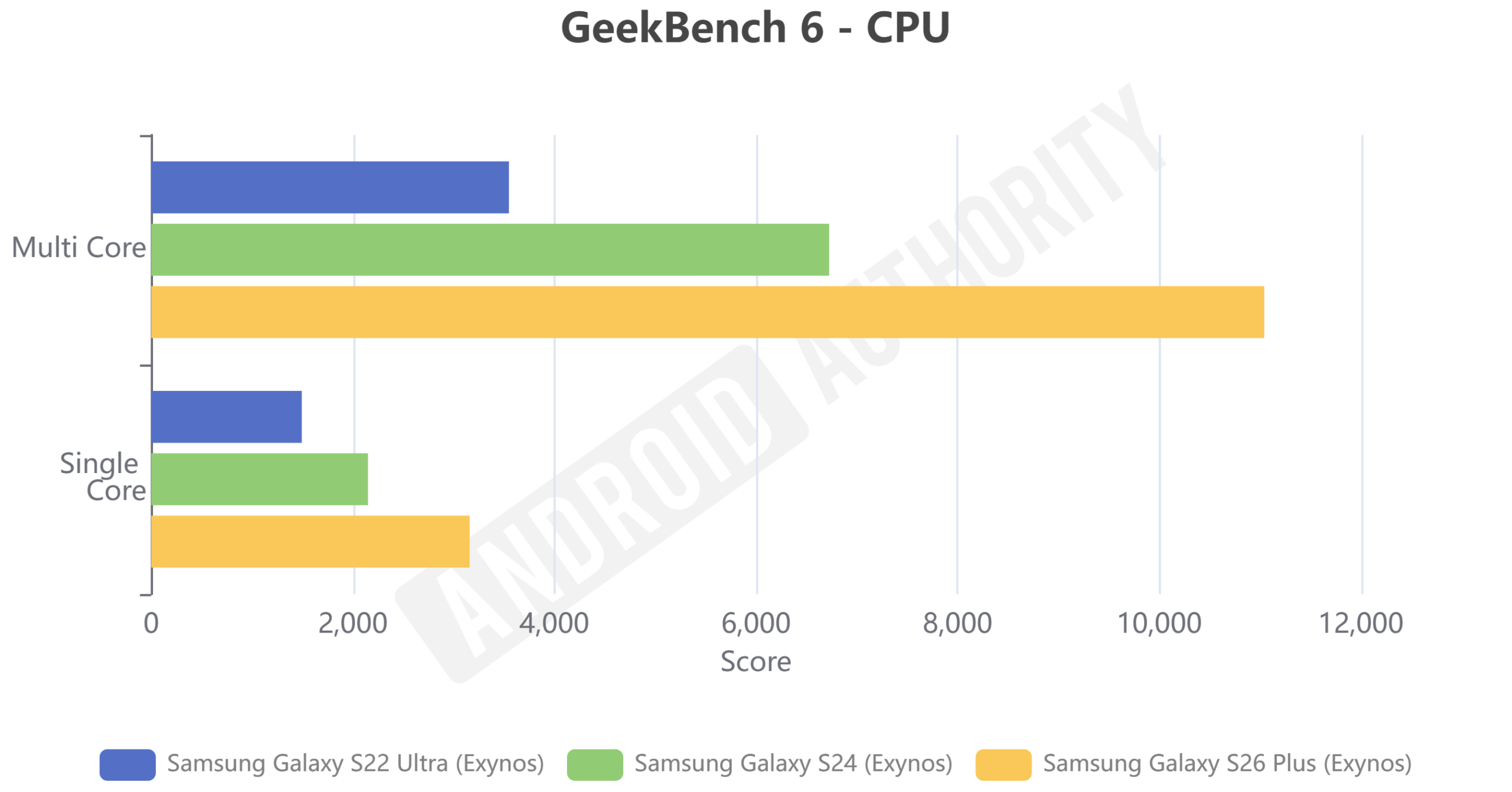
To assess the efficacy of Samsung’s efforts, a granular look at the performance trajectory of Exynos chips is imperative. Examining Exynos processors in isolation, particularly across recent Galaxy S flagships (excluding the Exynos 2500 in the Z Flip 7 for a more direct comparison with S-series counterparts), reveals substantial generational improvements.
Between the Exynos 2200 and the more recent Exynos 2600, single-core CPU performance, as measured by Geekbench 6, has seen a remarkable increase of 111%. The multi-core CPU performance exhibits an even more impressive surge of 211% over the same period. These figures demonstrate that Samsung’s integration of Arm’s off-the-shelf CPU cores, while not fully custom like Apple’s A-series or Qualcomm’s Kryo architectures, has scaled exceptionally well, delivering significant processing power gains. This sustained improvement is crucial for handling increasingly demanding applications, multitasking, and on-device AI workloads.
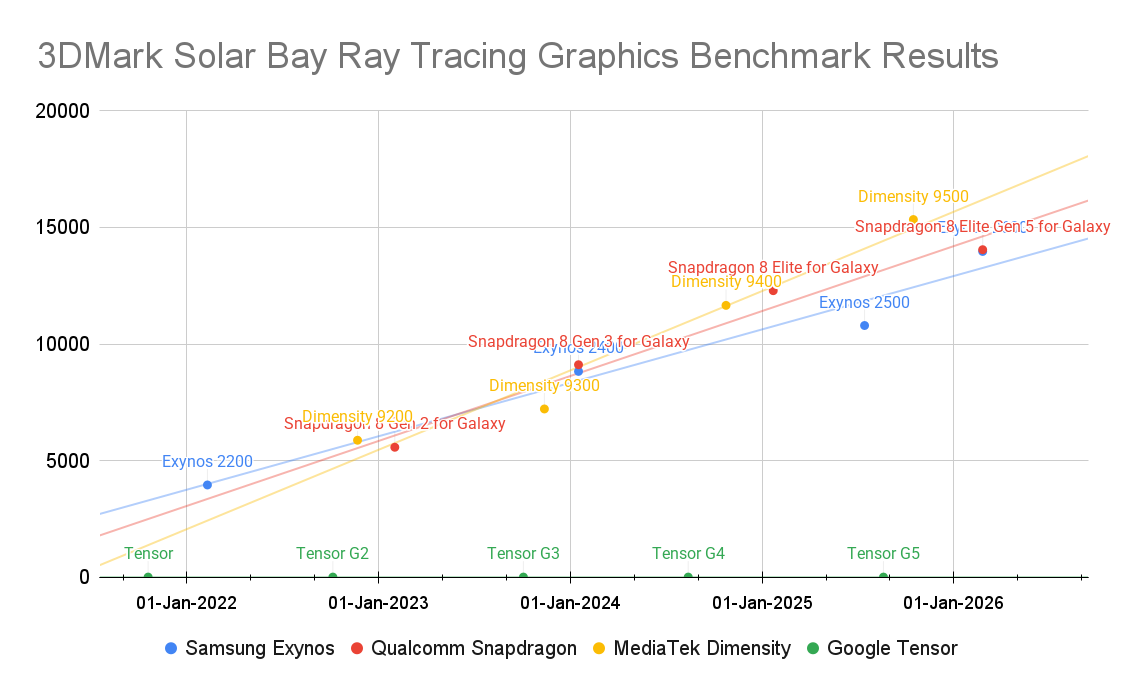
The graphics department tells a similarly compelling story of advancement. In 3DMark Wild Life Extreme, a benchmark for traditional rasterization graphics, performance has climbed by 212%. For ray tracing capabilities, tested with 3DMark’s Solar Bay, the performance leap is even more substantial, registering a 253% increase. These statistics underscore the maturation of AMD’s Xclipse GPU architecture within Exynos, with early driver issues seemingly ironed out, and the hardware now delivering the raw power expected from a modern flagship mobile GPU.
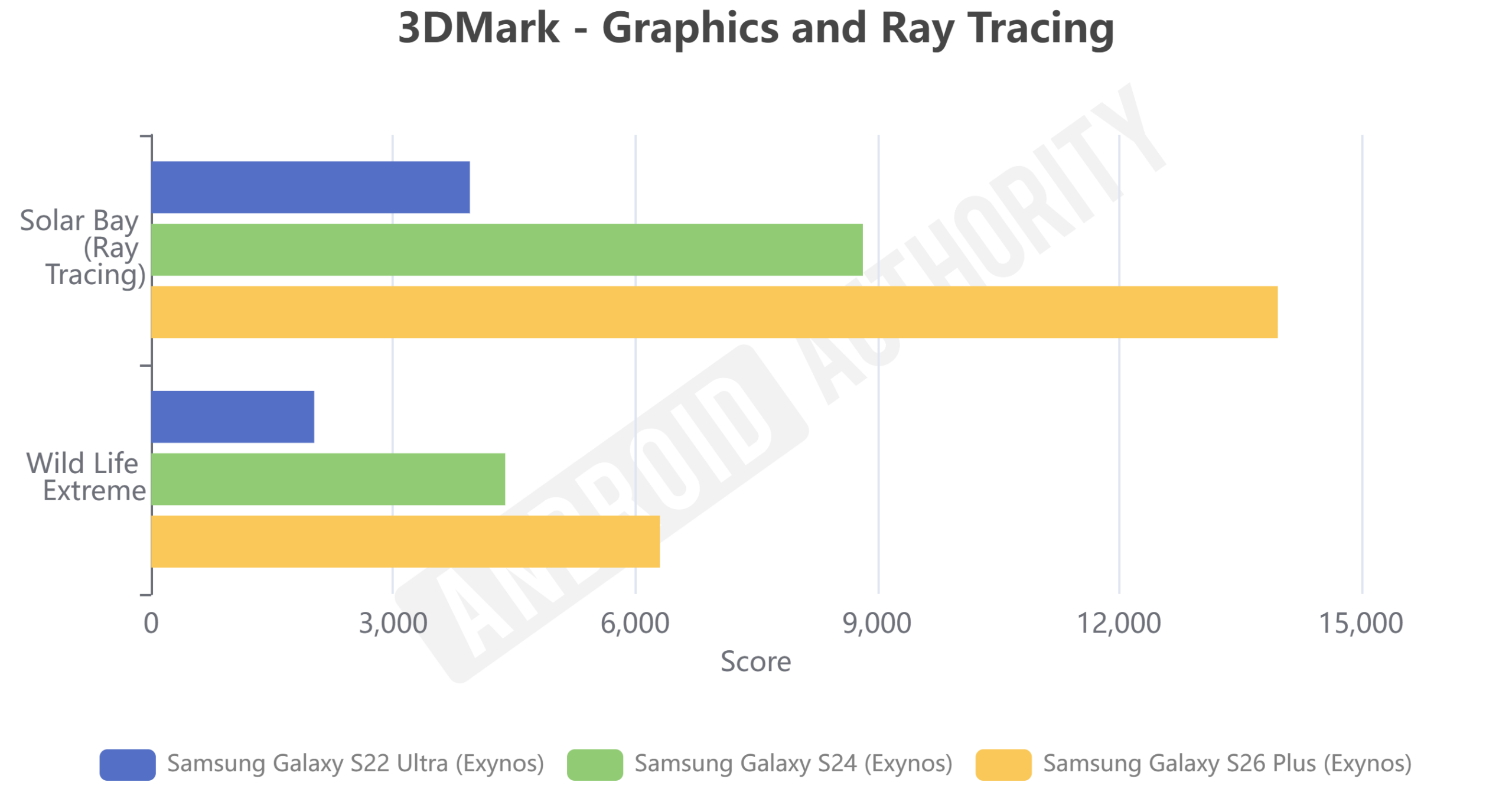
It’s important to note that a significant portion of this performance acceleration occurred with the introduction of the Exynos 2400, which nearly doubled performance outright compared to its predecessor. The subsequent Exynos 2600, while a more modest step, still delivered gains of 40-60% across various tests. In isolation, this trajectory is commendable and would be envied by many segments of the computing industry, including the PC market. However, the critical caveat remains: Exynos does not operate in isolation. Its progress must be evaluated against the rapid advancements of its primary competitors.
The Graphics Battle: AMD Xclipse vs. Arm Immortalis and Qualcomm Adreno
Samsung’s decision to shift to AMD’s RDNA architecture was a calculated gamble, intended to provide a clear competitive edge, particularly in gaming and advanced graphics features like ray tracing. While the Exynos 2200 was indeed an early adopter of hardware-accelerated ray tracing on mobile, this lead proved ephemeral. Qualcomm swiftly integrated ray tracing into its Snapdragon 8 Gen 2, launched shortly after, and Arm subsequently revamped its GPU lineup with the Immortalis series, also featuring ray tracing capabilities.
A direct comparison reveals that Samsung’s early advantage in ray tracing quickly evaporated. For instance, the Exynos 2200, despite its earlier launch, lagged approximately 33% behind MediaTek’s Dimensity 9200 (equipped with the Immortalis-G715) in the 3DMark Solar Bay ray tracing test. While the timing difference makes this comparison somewhat unfair, it highlights how quickly competitors caught up and, in some cases, surpassed Exynos. The cancellation of the Exynos 2300 in 2023, which likely would have been highly competitive based on trendlines, further exacerbated this gap. As of the Exynos 2600, it still trails the Dimensity 9500 by roughly 9% in ray tracing performance, indicating that Arm’s Immortalis GPUs have consistently outperformed Exynos in the very domain where AMD’s expertise was meant to dominate.
More broadly, in traditional rasterization, which remains the backbone for the vast majority of mobile games, Exynos has consistently lagged. The Exynos 2200 was approximately 45% slower than the Dimensity 9200 in the Wild Life Extreme benchmark. Even with the significant improvements in the Exynos 2600, it still sits about 19% behind rival chips from Qualcomm and MediaTek. This performance gap is, in fact, wider than what was observed in previous dual-chip Galaxy S generations, which is a concerning trend for Samsung’s flagship chipset. While considerations such as price, die area, and power consumption may have influenced Samsung’s strategic choices, from a pure gaming performance perspective, the AMD-powered Xclipse GPUs have not delivered a decisive advantage over competitors.
The Enduring Dominance of Snapdragon
The competitive landscape for mobile processors has seen Qualcomm’s Snapdragon series consistently maintaining a leadership position, especially at the premium end. A decade ago, Exynos and Snapdragon were often considered genuine peers, with performance often trading blows. However, in recent years, Snapdragon has consistently pulled ahead and solidified its dominance, particularly in benchmarks related to CPU performance, gaming, and increasingly, on-device artificial intelligence capabilities.
This consistent performance lead has directly influenced Samsung’s product strategy. Its Ultra models, representing the pinnacle of its smartphone offerings, have invariably featured Snapdragon-only configurations across all global markets. This decision underscores Qualcomm’s perceived superiority and the necessity for Samsung to equip its most premium devices with the best available silicon, regardless of its in-house ambitions. Consequently, this has perpetuated a familiar imbalance across global markets, where some consumers benefit from the faster, more efficient Snapdragon variant, while others in Exynos-designated regions receive a chip that, while improved, still trails its rival.
The financial rationale behind Samsung’s dual-chip strategy is complex. While developing in-house silicon can theoretically reduce reliance on external suppliers and potentially lower component costs in the long run, the massive research and development expenditures, coupled with manufacturing challenges and lower yields on advanced process nodes, can offset any short-term cost benefits. Given the extensive restructuring efforts within Samsung’s chip division and the reported yield issues, the immediate economic advantages of pushing Exynos are likely marginal compared to the strategic benefits of maintaining control over its silicon roadmap.
Strategic Imperatives and Future Outlook
Despite the performance gaps and historical challenges, Samsung’s commitment to Exynos remains a deeply strategic investment. The primary drivers are clear: gaining greater control over its silicon roadmap, significantly reducing its reliance on external suppliers like Qualcomm, and enabling deeper customization that can differentiate its Galaxy devices. This control extends to integrating proprietary technologies, such as Arm SME2 for enhanced AI processing or Heat Pass Block (HPB) technology in the Exynos 2600 for improved thermal management. These are features that Samsung can tailor precisely to its hardware and software ecosystem, potentially offering unique user experiences.
The generational gains achieved by Exynos are genuinely impressive, and the Exynos 2600 is by no means a slow chipset. However, the overarching conclusion remains that, across the past five Galaxy generations, Samsung’s custom silicon has consistently trailed its closest rivals, particularly Qualcomm and, in some aspects, MediaTek (Google’s Tensor, also manufactured by Samsung, represents a different strategic collaboration). The highly anticipated custom GPU for the Exynos 2800 and the impending conclusion of Samsung’s partnership with AMD will be critical junctures. These developments will indicate whether Samsung can finally bridge the performance gap and elevate Exynos to a truly peer-level competitor, or if it will continue to serve as a strategically important but ultimately secondary option to maintain supply chain diversity and negotiating leverage.
The future of Exynos is laden with high stakes for Samsung’s competitive standing in the global smartphone market. A successful revitalization could solidify its ecosystem, enhance differentiation, and improve profitability. Conversely, continued underperformance could further fragment its user base and potentially erode consumer confidence in its flagship offerings. The comeback with the Galaxy S26 marks a renewed challenge, and the industry will be watching closely to see if Samsung’s persistent investment in Exynos finally pays off.