
The Motorola Razr 70 emerges as a compelling contender in the burgeoning foldable phone market of 2026, aiming to blend retro charm with contemporary functionality. This review delves into the device’s capabilities, from its innovative external display to its overall user experience, evaluating its place among the best flip phones available today. With a starting price of $799.99 / £799.99, the Razr 70 positions itself as a more accessible entry into the premium foldable segment, a strategic move by Motorola to capture a wider audience seeking both style and substance.
A Deep Dive into the Motorola Razr 70’s Specifications
Motorola has equipped the Razr 70 with a robust set of specifications designed to deliver a smooth and responsive user experience. At its core lies the MediaTek Dimensity 7450X chipset, a capable processor that, while not flagship-tier, demonstrates impressive performance for everyday tasks and even moderate gaming. This is complemented by 8GB of RAM and 256GB of internal storage, providing ample space for applications, media, and files.
The primary display is a generous 6.9-inch LTPO Extreme AMOLED panel, boasting a fluid 120Hz refresh rate and a crisp resolution of 2,640 x 1,080 pixels. This screen is engineered for vibrant visuals, supporting HDR10+ and Dolby Vision, making it ideal for content consumption. A significant highlight is its impressive peak brightness of 3,000 nits, ensuring excellent visibility even in challenging lighting conditions.
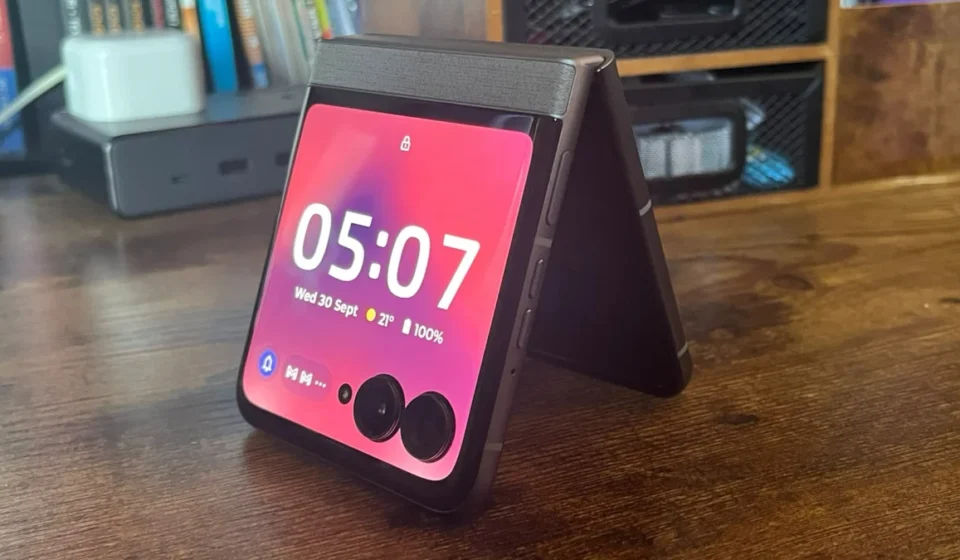
Complementing the main display is a highly functional 3.6-inch external AMOLED screen with a 90Hz refresh rate and a resolution of 1,056 x 1,066 pixels. This secondary display is a key differentiator, offering a level of interactivity that transcends a mere notification hub. The device is powered by a substantial 4,800mAh battery, which, coupled with TurboPower charging capabilities, promises efficient power management and quick top-ups.
The camera system comprises a versatile dual-lens setup on the rear: a 50MP main sensor with Optical Image Stabilization (OIS) and a 50MP ultrawide/macro lens. For selfies and video calls, a 32MP front-facing camera is integrated. The phone’s physical design is notably compact when folded, measuring 88.08 x 73.99 x 15.85mm, and unfolds to a slim 171.30 x 73.99 x 7.25mm. Weighing in at a relatively light 188g for a foldable, it comes in three distinct colorways: Pantone Hematite, Sporting Green, and Bright White, each offering a unique aesthetic.
Performance and Gaming: A Balanced Approach
The Motorola Razr 70’s performance, driven by the MediaTek Dimensity 7450X, strikes a commendable balance between efficiency and responsiveness. During daily use, the device operates with a satisfying snappiness, launching applications swiftly and handling multitasking without noticeable lag. This smooth performance extends impressively to the external display, transforming quick interactions into seamless experiences.

While the Razr 70 is not positioned as a dedicated gaming phone, it handles casual games with ease. For more demanding titles like Call of Duty: Mobile, the external screen offers an intriguing, albeit challenging, option. Although playing on the smaller external display presents some ergonomic hurdles and a slight dip in frame rates, it remains a viable, albeit niche, option for on-the-go gaming. The optimized controls for the outer panel are a thoughtful addition, but for extended gaming sessions, unfolding the device to the full 6.9-inch display is the preferred route. This approach acknowledges that while the external screen offers convenience, the primary gaming experience is best realized on the larger internal display.
Software and Features: The External Display as a Game-Changer
Running on Android 16 with Motorola’s signature software layer, the Razr 70 incorporates Moto AI and a suite of intuitive gestures and shortcuts. The standout feature, without question, is the 3.6-inch external display. Motorola has elevated this component from a simple notification panel to a genuinely interactive interface. Users can seamlessly interact with a wide array of applications, respond to messages, manage music playback, and utilize navigation tools without needing to unfold the phone.
This enhanced functionality significantly streamlines daily workflows. Whether controlling Spotify playback while preparing a meal, quickly accessing WhatsApp messages, or engaging in a brief social media scroll before a movie, the external display provides instant access. This makes the cover screen not just a novelty, but a powerful tool for efficiency and convenience.
The level of customization available for the external display is extensive. Users can assign a variety of applications and arrange different panels to suit their preferences. This flexibility allows for personalized layouts, such as prioritizing a calendar view for quick access to schedules or placing frequently used widgets within easy reach. The inclusion of iPhone-style layouts and handy widgets further enhances the user experience, offering a familiar yet adaptable interface.
However, the software experience is not without its minor flaws. The reviewer noted occasional issues with notification settings reverting to their default state, suggesting a potential software bug that Motorola may address in future updates.
Beyond the external display, Motorola’s signature movement gestures add another layer of user-friendly interaction. The "torch shake" gesture, for instance, allows for immediate activation of the flashlight with a simple flick of the wrist, a practical and surprisingly delightful feature. These small, intuitive gestures contribute to the overall "fun factor" of the device, reinforcing Motorola’s philosophy that phones should be enjoyable to use, not just utilitarian.
A point of concern for some users might be Motorola’s software update policy. While the Razr 70 is slated to receive up to three years of OS upgrades and security support through 2030, this falls short of the longer support windows offered by some competitors, such as Samsung. This disparity is an important consideration for consumers prioritizing long-term software longevity.

Design and Durability: A Blend of Aesthetics and Resilience
The Motorola Razr 70 serves as a potent reminder that smartphone design can transcend mere functionality, embracing personality and flair. The available color options – Pantone Hematite, Sporting Green, and Bright White – are a departure from the monochromatic offerings of many competitors, imbuing the device with a distinctive character. At 188g, it strikes a good balance between a solid feel and portability, particularly for a foldable device.
When folded, the Razr 70 achieves a remarkable level of compactness, easily fitting into pockets and small bags. Unfolding it reveals a full-sized 6.9-inch display, offering a familiar and expansive smartphone experience. While its folded thickness of 15.85mm places it among the slightly thicker flip phones, the overall design feels intentional and well-crafted.
Motorola has incorporated a titanium-reinforced hinge, a testament to the device’s build quality and durability. Furthermore, the inclusion of IP48 water and dust resistance, while not groundbreaking in 2026, provides a welcome layer of reassurance against everyday environmental hazards. The bundled case, while a thoughtful inclusion, may not appeal to all aesthetic preferences, prompting some users to seek out third-party options for a more personalized look.
Display Technology: Immersive Visuals with a Caveat
The primary 6.9-inch LTPO AMOLED display on the Razr 70 is a visual treat. Its 120Hz refresh rate ensures buttery-smooth scrolling and fluid animations, while support for HDR10+ and Dolby Vision enhances the viewing experience with vibrant colors and deep contrasts. The display’s ability to reach a peak brightness of 3,000 nits is a significant advantage, guaranteeing legibility even under direct sunlight.
A crucial point of consideration for users is the integrated screen protector. Motorola explicitly warns against its removal, stating that doing so can damage the display and void the warranty. This policy, clearly communicated during the setup process, means the factory-installed protector is a permanent fixture.
Despite initial concerns about the display crease, the reviewer found it to be surprisingly unobtrusive. While visible from certain angles, it becomes virtually unnoticeable during everyday use, particularly when viewed directly. The 3.6-inch external AMOLED display, with its 1056 x 1066 resolution and 90Hz refresh rate, offers a sharp and responsive interface for quick tasks. Its protection with Gorilla Glass Victus further enhances its durability.
Camera Capabilities: Versatile for Everyday Moments
The Motorola Razr 70 features a capable camera system designed to capture everyday moments effectively. The 50MP main sensor, equipped with OIS, delivers sharp and vibrant photos in good lighting conditions, showcasing plenty of detail. The 50MP ultrawide/macro lens provides added versatility, allowing for broader perspectives and close-up shots, although image quality may see a slight degradation in challenging lighting.

While the zoom capabilities are not a strong suit, the camera system is more than adequate for social media sharing and general photography. Motorola has cleverly leveraged the foldable form factor to enhance the camera experience. Features like Flex View enable hands-free shooting by propping the phone up, while Frame Match and Gesture Selfie offer creative ways to capture group shots and selfies.
The inclusion of modes such as Photo Booth, Macro, Night Vision, and Twist to Capture adds to the creative potential. A particularly innovative feature is the Camcorder mode, which allows users to hold the partially folded phone like a traditional camcorder for video recording, complete with dedicated touch controls and an intuitive auto-zoom function activated by tilting the device.
Battery Life and Charging: Enduring Power for a Foldable
The 4,800mAh battery is a significant strength of the Motorola Razr 70, offering impressive endurance for a foldable device. Despite a slightly smaller capacity compared to some non-foldable competitors, the Razr 70 comfortably lasts a full day of moderate to heavy usage, alleviating the common concern of battery anxiety associated with foldable phones.
Charging is efficient thanks to Motorola’s TurboPower technology. Using a 30W charger, the device can reach approximately 55-60% charge in about 25 minutes from empty. Wireless charging is also supported, albeit at a slower 15W rate. This combination of long-lasting battery life and rapid charging ensures that users can stay connected and productive throughout their day without constant worry.
Verdict: Is the Motorola Razr 70 Your Next Flip Phone?
The Motorola Razr 70 successfully carves out its niche by prioritizing user experience and personality over raw specification benchmarks. While it makes concessions in areas such as camera zoom capabilities, peak gaming performance, and long-term software support compared to some premium rivals, these compromises do not detract from its overall appeal.
In fact, the reviewer found that the device fostered an unexpected appreciation for its unique features. The external display, in particular, evolved from a potential gimmick to an indispensable tool for everyday tasks. Motorola’s intuitive gesture controls also added a layer of enjoyable interaction, reinforcing the idea that technology should be both functional and fun.
Priced at $799.99 / £799.99, the Razr 70 represents a compelling entry point into the foldable market for those who have been curious about the form factor but hesitant to invest in the highest-priced options. It offers a well-rounded experience that successfully blends nostalgic design with modern innovation, making a strong case for consumers looking to embrace the flip phone revival. While it may not be the perfect phone for every user, the Razr 70 undeniably makes a convincing argument for why the flip phone is back and better than ever.

Notable Alternatives in the Foldable Market
For consumers considering the Motorola Razr 70, several other notable flip phones offer compelling alternatives, each with its own strengths and target audience.
Samsung Galaxy Z Flip5: A direct competitor in the premium foldable space, the Samsung Galaxy Z Flip5 offers a more performance-oriented experience, powered by a potent Snapdragon 8 Gen 2 chip and Samsung’s refined software ecosystem. While its starting price was higher than the Razr 70’s, the Z Flip5 remains a strong contender for users prioritizing raw power and a well-established brand reputation. Its larger external display, while functional, does not offer the same level of interactive depth as the Razr 70’s.
Nubia Flip 5G: Positioned at the more affordable end of the foldable spectrum, the Nubia Flip 5G provides an attractive option for budget-conscious consumers. It features a stylish design and handles everyday tasks with reasonable competence. Its camera and performance capabilities are more modest, reflecting its lower price point. However, its fast charging is a standout feature, and it offers a solid entry into the foldable market. Availability can sometimes be a challenge, making thorough research on procurement essential.