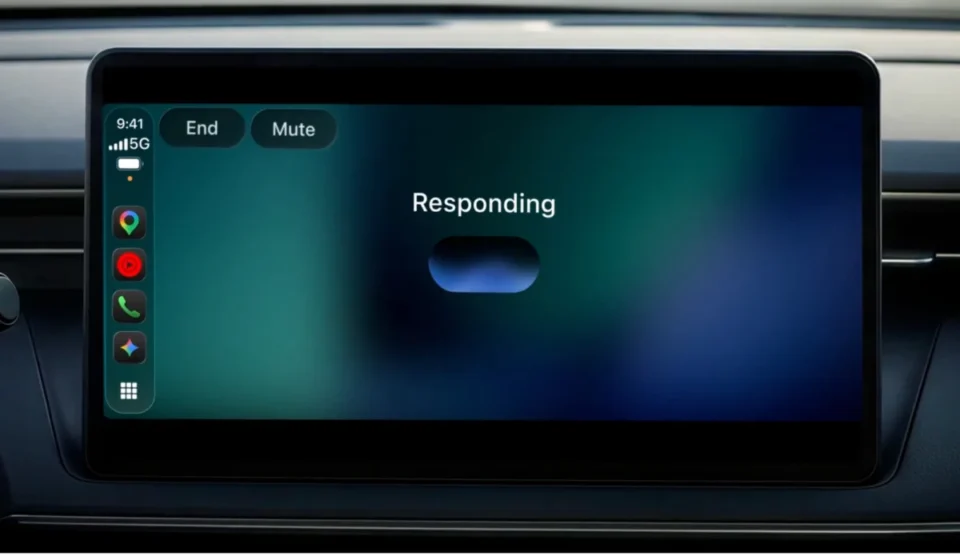

Google Gemini is poised to revolutionize in-car digital assistance with its integration into Apple CarPlay, marking a significant stride in hands-free AI interaction for drivers. As of November 11, 2026, users of iPhones connected to compatible vehicles will be able to access Gemini’s advanced conversational capabilities directly through their car’s infotainment system. This rollout signifies Google’s strategic push to embed its powerful AI model into daily life, extending its reach to the increasingly connected automotive environment.
The integration brings Gemini Live, Google’s sophisticated voice-chat mode, to the forefront of the driving experience. This feature allows for natural, flowing conversations with the AI, enabling users to interrupt mid-response, seamlessly transition between topics, and engage in a more dynamic exchange than traditional voice commands. A visual waveform on the car’s display will indicate Gemini’s listening, thinking, and speaking status, providing clear feedback to the user.
Key Functionalities of Gemini on CarPlay

Gemini’s capabilities extend far beyond basic voice commands. Leveraging its deep integration with Google services, the AI can now act as a proactive assistant for drivers. One of the most compelling features is its ability to access and process information from a user’s Gmail and Google Calendar. This allows Gemini to provide a "daily brief" on upcoming appointments, summarize unread emails, and even help draft spoken replies to messages, all without the driver needing to take their hands off the wheel or their eyes off the road.
- Calendar Integration: Drivers can inquire about their schedule, receive reminders for upcoming meetings, and even get a summary of their day’s events. For instance, a user could ask, "Gemini, what’s on my agenda for this afternoon?" and receive a concise overview of their commitments.
- Email Management: Gemini can sift through an inbox, providing summaries of important or unread emails. This is particularly useful for catching up on work-related correspondence during a commute. The AI can also facilitate quick responses, allowing drivers to dictate replies that can then be sent.
- Contextual Conversations: Building on its previous advancements, Gemini retains the context of ongoing conversations. This means users can pick up where they left off in a previous chat, whether it was about planning a route, discussing a news topic, or managing their schedule.
- Hands-Free Interaction: The core of the CarPlay integration is its hands-free operation. Gemini Live is designed for natural language processing, meaning users can speak to it as they would to another person, fostering a more intuitive and less distracting user experience.
Background and Chronology of AI Integration in Vehicles
The integration of AI assistants into vehicle dashboards is not a new phenomenon, but the sophistication and depth of capabilities have evolved rapidly. Early in-car voice systems were often limited to basic commands like navigation or phone calls. However, the advent of more advanced AI models, coupled with the increasing adoption of smartphone integration platforms like Apple CarPlay and Android Auto, has paved the way for more intelligent and conversational assistants.

- Early 2010s: Basic voice recognition systems begin to appear in vehicles, primarily for controlling essential functions.
- Mid-2010s: The introduction of Apple CarPlay and Android Auto allows drivers to mirror their smartphone interfaces on their car’s display, bringing familiar apps and voice assistants (like Siri and Google Assistant) into the vehicle.
- Late 2010s – Early 2020s: AI models become more capable of understanding natural language and performing more complex tasks. Dedicated in-car AI assistants begin to emerge from automakers, often focusing on vehicle-specific functions.
- 2023-2024: Major AI companies, including Google and OpenAI, begin to develop and refine AI models specifically for conversational and multimodal applications. Google announces Gemini, a powerful new family of AI models.
- iOS 26.4 (Hypothetical Release): Apple’s CarPlay platform opens up to third-party voice-based AI applications, marking a significant shift in its ecosystem. This allows for a wider array of AI assistants to be integrated, moving beyond Apple’s native Siri.
- November 11, 2026: Google begins the rollout of its Gemini app on Apple CarPlay, making a sophisticated conversational AI available directly to iPhone users in their vehicles.
Competitive Landscape and Broader Implications
The inclusion of Gemini on CarPlay places it in a rapidly growing field of AI assistants vying for a presence in the automotive infotainment system. With iOS 26.4 opening the door to such integrations, other major AI players have already made their mark:
- ChatGPT: OpenAI’s flagship AI model is available, offering its extensive knowledge base and conversational abilities.
- Perplexity AI: Known for its research-oriented approach, Perplexity offers an AI that can answer questions with cited sources.
- Microsoft Copilot: Microsoft’s AI assistant, integrated into many of its products, also finds a place in CarPlay, offering productivity and information retrieval features.
- Meta AI: Meta’s AI, powered by its Llama models, provides conversational capabilities and access to real-time information.
- Grok: Elon Musk’s AI chatbot, known for its real-time access to information from X (formerly Twitter), is also present.
The competition among these AI models on CarPlay highlights a significant trend: the democratization of advanced AI. What was once confined to desktops and specialized hardware is now readily accessible through personal devices and integrated into everyday environments like vehicles.

Analysis of Impact on Drivers and the Automotive Industry
The widespread adoption of advanced AI assistants in cars, exemplified by Gemini’s CarPlay integration, has several profound implications:
- Enhanced Driver Safety and Productivity: By enabling hands-free access to information and communication tools, these AI systems can reduce driver distraction. The ability to manage schedules, emails, and receive timely updates without manual interaction can significantly boost productivity for those who use their vehicles for work.
- Personalized In-Car Experience: As AI models learn user preferences and integrate with personal accounts (like calendars and emails), the in-car experience becomes increasingly personalized. This moves beyond simple infotainment to a truly assistive environment.
- Shift in Automotive Software Development: Automakers may face increased pressure to enhance their own in-car software and AI capabilities to compete with the sophisticated offerings from tech giants like Google. This could lead to faster innovation cycles and a greater emphasis on software-defined vehicles.
- Data Privacy and Security Concerns: The deep integration of personal data (emails, calendars, location history) raises important questions about data privacy and security. Users will need to be aware of how their data is being used and protected by both Google and Apple.
- Potential for New Revenue Streams: The integration of AI services could open up new avenues for revenue for both technology companies and automakers, potentially through premium subscription models or enhanced service offerings.
Requirements for Accessing Gemini on CarPlay

To fully utilize Gemini’s capabilities within Apple CarPlay, users will need to meet a few prerequisites:
- Latest Gemini App: The most recent version of the Google Gemini app must be installed on the user’s iPhone.
- Microphone Permissions: The Gemini app will require microphone permissions to enable voice interactions.
- Prior Gemini Live Session: At least one prior Gemini Live session must have been initiated on the user’s phone. This likely helps the app establish necessary configurations and user preferences.
- Daily Brief Enabled: For the "Daily Brief" feature to function, it must be explicitly switched on within the Gemini app’s settings.
The introduction of Gemini on Apple CarPlay represents a significant evolutionary step in how we interact with technology while on the move. It transforms the car’s dashboard from a simple display and control center into an intelligent, conversational partner, capable of managing a driver’s digital life with unprecedented ease and safety. As AI continues to mature, its integration into our vehicles is set to redefine the driving experience, making it more connected, efficient, and potentially safer than ever before.